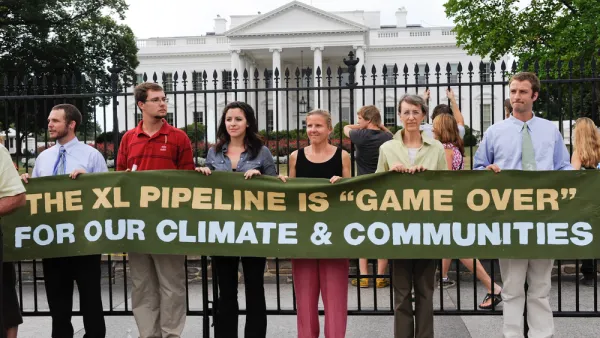
The fight to block approval of the Keystone XL pipeline has galvanized support like few recent controversies. But is there a danger in focusing so much attention on one decision when there are innumerable threats to the climate across North America?


"Much of the United States climate movement right now is structured like an archway, with all of its blocks resting on a keystone – President Obama’s decision on the Keystone XL pipeline," write climate activists Arielle Klagsbrun, David Osborn, Kirby Spangler and Maryam Adrangi. "This is a dangerous place to be. Once Barack Obama makes his decision on the pipeline, be it approval or rejection, the keystone will disappear. Without this piece, we could see the weight of the arch tumble down, potentially losing throngs of newly inspired climate activists."
"The Keystone XL and Northern Gateway fights have engaged hundreds of thousands of people, with many embracing direct action and civil disobedience tactics for the first time. This escalation and level of engagement is inspiring. But the absolutist 'game over' language chances to lose many of them," they warn. "We need those using the 'game over' rhetoric to lay out the climate crisis’ root causes – because just as one project is not the end of humanity, stopping one project will not stop runaway climate change."
Read the full story: The Climate Movement’s Pipeline Preoccupation
Developer Drops Keystone XL Plans
It's the latest turn of the screw for a project that has depended on the occupant in the White House.
President Obama and Prime Minister Trudeau Agree to Reduce Methane Emissions
Climate change was front and center at a Thursday morning joint press conference at the White House, where U.S. President Barack Obama and Canadian Prime Minister Justin Trudeau agreed to several energy, environmental, and Arctic initiatives.
Could Keystone XL Become the Next Casualty of Falling Oil Prices?
Recently we noted that Chevron had dropped their Arctic lease due to falling oil prices. With falling gasoline prices, Americans may no longer see the Keystone XL pipeline as urgent. In addition, President Obama appears likely to oppose the project.

Desperate measures: Advocates weigh draining Lake Powell to fill Colorado River
Draining the reservoir could reduce evaporation losses by a couple hundred thousand acre-feet.

Eastern Nebraska is running out of electricity
Data centers and electrification are straining eastern Nebraska’s grid, throttling economic development.

Malls are becoming the midtowns of the future
Mall and office park redevelopments are a generational opportunity to create new nodes of urbanity.

NYC breaks ground on anti-flooding infrastructure project
New York City's new system will reduce stormwater flows to local sewers by 90%.

One Kentucky town’s secret to affordable housing
The Smoketown Community Land Trust has already built seven affordable homes for community members.

Houston gains petal-shaped cooling infrastructure to make streets more ‘delightful’
The city has installed the pavilions along 15 blocks in Houston.

FREE Course: Walkable City 1: Why Walkability?
After describing his path towards focusing on walkability as the essence of good planning, Jeff Speck marches through his five principal reasons for making more walkable places.
Reinventing Malls: Planning Alchemy—Turning Gray Fields Into Gold
The course focuses on the opportunities and imperatives that shape reinvention of mall sites.

City of Rosemead
Rutgers University, Edward J. Bloustein School of Planning and Public Policy
One Hundred Miles
University of Michigan School for Environment and Sustainability (SEAS)
Hunter College, City University of New York (CUNY)
The Architects Foundation
City of Cambridge
Montrose County
The Pocatello Development Authority