The $300 million in federal and private aid announced Friday for Detroit is just a drop in the bucket compared to the city's $18 billion debt. While the aid is far short of a bailout, it represents a down payment on the city's recovery.


"Top Obama administration officials and local leaders unveiled a strategy to bring $300 million in federal and private-sector help to Detroit today to fight blight, improve the city’s struggling bus system, boost public safety and encourage business growth in a city fighting for survival in bankruptcy court," report Matt Helms and Todd Spangler.
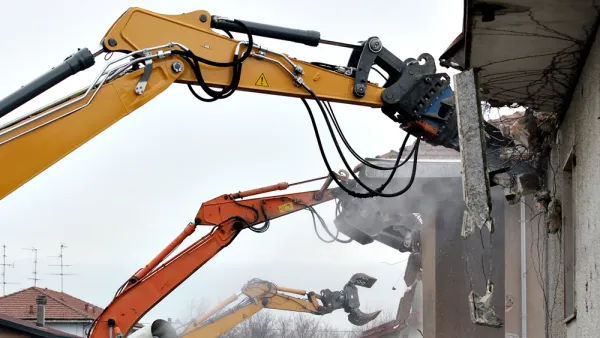
"The money will include $150 million for blight removal and redevelopment. Of that, a $65 million block grant and $25 million in public and private funding will be used to demolish vacant commercial buildings," they note. "The $300 millions will also include $14 million for transit and $25 million to hire as many as 140 firefighters."
“This is critical,” said emergency manager Kevyn Orr. “We still are in a bankruptcy. We’re still going to have to go through that process, we’re still going to have to work our way through the debt, but this is aimed at neighborhood revitalization.”
Read the full story: $300M federal, private boost for Detroit: 'We are going to do everything we are capable of'


Detroit Mayor Proposes Vacant Lot Tax
A new tax plan would reform the city’s famously low vacancy tax rates in an effort to stimulate more housing development and limit speculation.

Dan Gilbert Announces $500 Million Investment in Detroit Neighborhoods
Dan Gilbert, the billionaire credited with the revitalization of development interest in and around Downtown Detroit, made a bombshell announcement in his first in-depth interview since suffering a stroke in 2019.
$160 Million in Bond Funding for Demolitions on the Ballot in Detroit
Proposal N, on the ballot for Detroit voters next week, will provide $160 million in bond funding for demolitions and $90 million to mothball homes for future rehab, but, according to this opinion, it won't solve the city's blight challenges.

Planetizen Federal Action Tracker
A weekly monitor of how Trump’s orders and actions are impacting planners and planning in America.

‘Going backwards:’ Baltimore mayor, students rally against state's transit funding plan
Maryland's proposed six-year plan provides no funding for Baltimore’s BMORE bus program and reduces its road maintenance funding.

Detroit to transform waterfront with $2.2 billion investment
Developers will convert about 18 acres of unused parking lot space into civic spaces.

Michigan Senate votes to revise 'lax' dam safety laws
A Bridge Michigan investigation found more than 100,000 Michigan residents live in the floodpath of a high or significant-hazard dam.

NYC’s landfills will soon overflow — expanding them invites health risks
In as little as 16 years, New York City will have to find new places to dump its trash.

This Boston neighborhood is filling its roads with obstacles — intentionally
Somerville is embracing ‘extreme street makeovers’ to make its roads safer for pedestrians and cyclists.

FREE Course: Walkable City 1: Why Walkability?
After describing his path towards focusing on walkability as the essence of good planning, Jeff Speck marches through his five principal reasons for making more walkable places.
Reinventing Malls: Planning Alchemy—Turning Gray Fields Into Gold
The course focuses on the opportunities and imperatives that shape reinvention of mall sites.

City of Thousand Oaks
City of Wisconsin Rapids
Harvard University Graduate School of Design
The Architects Foundation
University of Cincinnati Online
Northern Illinois Transit Authority (NITA)
The Pocatello Development Authority
The Urban Renewal Agency of the City of Pocatello