You're probably thinking "Way too many cars on the road, duh!" But the real answer is a bit more complicated, and counterintuitive. Tom Vanderbilt explains in a 20-minute presentation.


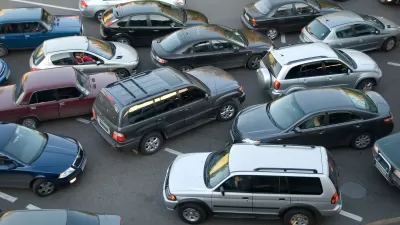
"Tom Vanderbilt, author of Traffic, gave a great 20-minute overview on the counterintuitive science of congestion at the Boing Boing: Ingenuity conference in San Francisco last month," writes Eric Jaffe. "Turns out a lot of the problems we ascribe to poor roads or other drivers are really our own fault. '[T]he individual driver cannot often understand the larger traffic system,' says Vanderbilt."
Among the nuggets: "A big reason for traffic is that too many cars are trying to occupy too little space on the road," notes Jaffe. Aha, see I told you you were right!
"But that's not the only problem. A human inability to maintain a steady speed and following distance on the highway makes traffic a lot less smooth than it could be."
Read the full story: A Fantastically Clear, Concise Explanation of Why Traffic Happens

Congestion Costing Reality Check, Part 2: A congestion costing critique
There are good reasons to be skeptical of highway industry claims that traffic congestion is a growing problem. Their analysis is often incomplete and biased. Let’s pull back the curtain on some major congestion cost studies.
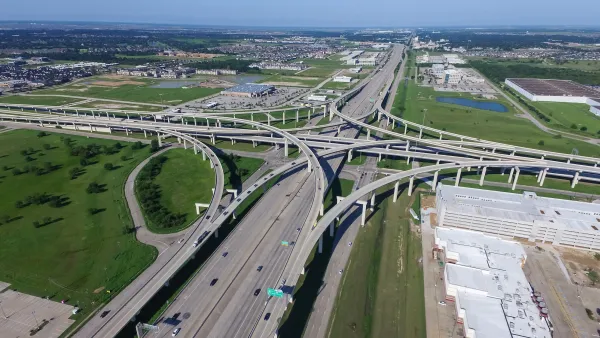
Induced demand is real: Commutes on Houston's 26-lane freeway take 51% longer after expansion
A massive freeway expansion only led to longer drive times, showing that building more lanes won't solve congestion.
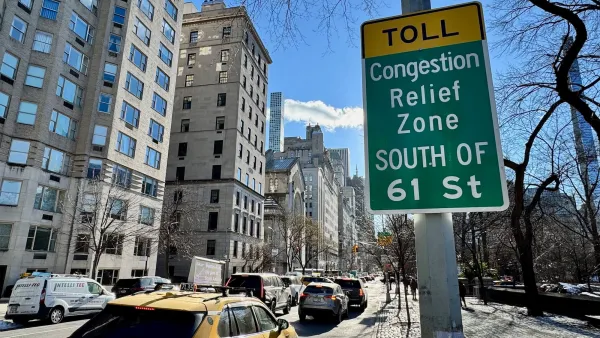
Study: NYC congestion pricing didn't impact parking demand
A city report shows that free parking, not congestion pricing, is the main driver of limited parking demand in the city.

Planetizen Federal Action Tracker
A weekly monitor of how Trump’s orders and actions are impacting planners and planning in America.

‘Going backwards:’ Baltimore mayor, students rally against state's transit funding plan
Maryland's proposed six-year plan provides no funding for Baltimore’s BMORE bus program and reduces its road maintenance funding.

Detroit to transform waterfront with $2.2 billion investment
Developers will convert about 18 acres of unused parking lot space into civic spaces.

Michigan Senate votes to revise 'lax' dam safety laws
A Bridge Michigan investigation found more than 100,000 Michigan residents live in the floodpath of a high or significant-hazard dam.

NYC’s landfills will soon overflow — expanding them invites health risks
In as little as 16 years, New York City will have to find new places to dump its trash.

This Boston neighborhood is filling its roads with obstacles — intentionally
Somerville is embracing ‘extreme street makeovers’ to make its roads safer for pedestrians and cyclists.

FREE Course: Walkable City 1: Why Walkability?
After describing his path towards focusing on walkability as the essence of good planning, Jeff Speck marches through his five principal reasons for making more walkable places.
Reinventing Malls: Planning Alchemy—Turning Gray Fields Into Gold
The course focuses on the opportunities and imperatives that shape reinvention of mall sites.

City of Thousand Oaks
City of Wisconsin Rapids
Harvard University Graduate School of Design
The Architects Foundation
University of Cincinnati Online
Northern Illinois Transit Authority (NITA)
The Pocatello Development Authority
The Urban Renewal Agency of the City of Pocatello