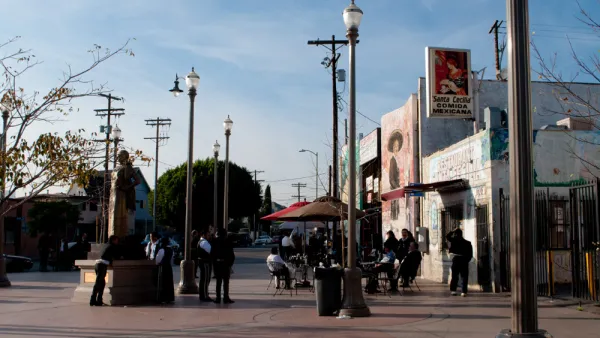
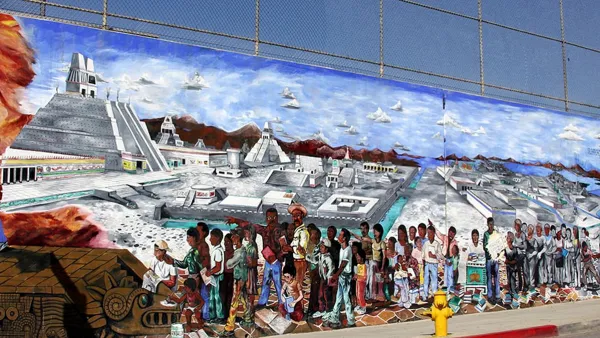
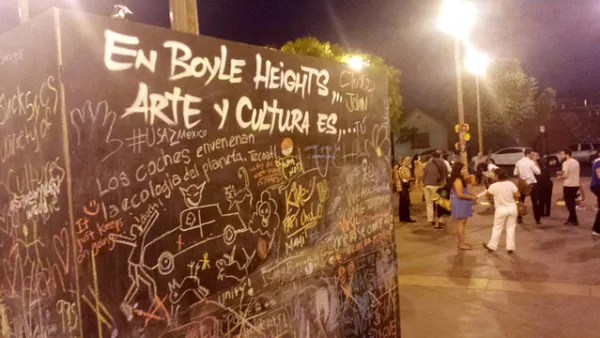
Those investing in the largely Latino enclave of Boyle Heights prefer to use the term "gentefication" - a play on the Spanish word for people - rather than the pejorative gentrification, to describe their efforts to improve the L.A. neighborhood.


"The transition [of Boyle Heights into an area popular with more well-to-do and younger Mexican-Americans] has provided a jolt of energy and a transfusion of money, but it has also created friction with working-class residents here," observes Jennifer Medina. "And tensions over just whom this neighborhood belongs to are a clear sign that Latinos have come of age in Los Angeles, where they are expected to become the majority this year."
“'We’re not trying to get out of the barrio, we’re trying to bring the barrio up,' said Marco Amador, who runs an Internet radio station out of a storefront he helped open in Boyle Heights last fall."
“It’s really easy to say no to things, but the harder question is how do we change things and empower people at the same time,” attorney Alfred Fraijo said. “If we’re closed to outsiders, we’re going to be stuck in the past. If we can figure out how to say yes to development and history at the same time, we can really be a model for this city that hasn’t had one yet.”
Read the full story: Los Angeles Neighborhood Tries to Change, but Avoid the Pitfalls
The Racial Complexities of Gentrification in L.A.
In some Latino neighborhoods, the gentrifiers are also Latinos. The result is a complicated mix of culture, change, and resistance.
'Vida' Examines Gentrification in East L.A. But Now Faces Backlash from Real-Life Protesters
A show about the impacts of gentrification in a working-class immigrant neighborhood in Los Angeles is generating controversy among those it represents.
Why L.A.'s Boyle Heights Matters to Anti-Gentrification Activists
The historically Latino working class neighborhood is a frequent touchstone in debates over gentrification in Los Angeles. That history goes back decades and colors residents' perceptions.

Washington state to charge fee to drivers with fuel-efficient cars
Revenue from the fee will go towards supporting the state’s highways.

Illinois considers spending $1 billion in taxpayer money on data center
A quantum computing campus and data center are currently under construction in Chicago.

Trump to blast ‘hydrocarbon highway’ through ‘world’s longest art gallery’
Environmental and historic preservation groups are suing to stop the project.

NYC, state sue feds over mixed-immigration-status housing assistance rule
The state’s lawsuit argues that the rule change violates the Administrative Procedure Act.

Michigan to turn neighborhood into virtual power plant
Residents will soon be able to divert their excess energy to the grid in exchange for compensation.

Data center, mining project swarm to long-awaited Alaska railroad line
The state-owned railroad approved final plans for the spur line this week; the project is expected to cost $311 million, mostly funded by the federal government

FREE Course: Walkable City 1: Why Walkability?
After describing his path towards focusing on walkability as the essence of good planning, Jeff Speck marches through his five principal reasons for making more walkable places.
Reinventing Malls: Planning Alchemy—Turning Gray Fields Into Gold
The course focuses on the opportunities and imperatives that shape reinvention of mall sites.

City of Charlotte
City of Rosemead
Rutgers University, Edward J. Bloustein School of Planning and Public Policy
University of Michigan School for Environment and Sustainability (SEAS)
Hunter College, City University of New York (CUNY)
The Architects Foundation
University District Partnership