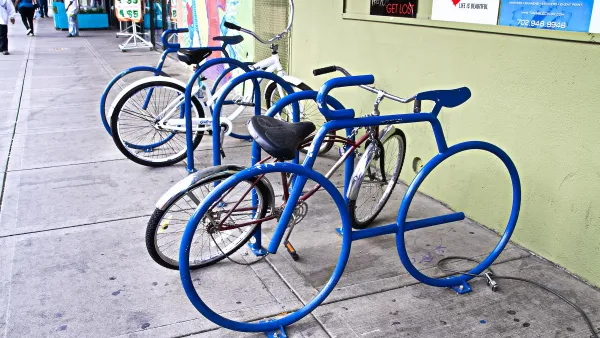
It might be a stretch to think that attractive sidewalk bike racks will increase motorists' willingness to "share the road", but it helped a bike shop owner convince the city of Hayward, Calif. to approve the installation of the $450 racks.


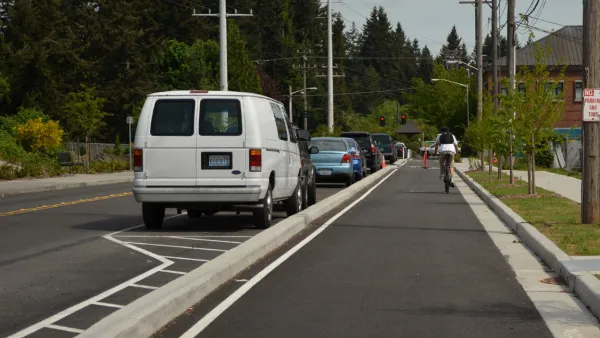
Rebecca Parr writes of the successful effort by Ben Schweng, owner of the Cyclepath bicycle shop, to have the racks installed along Foothill Blvd, including near his downtown shop which is located on a new, downtown street configuration known as the Hayward Loop (part of the Rte.238 Mission Corridor Improvement Project) that appears to be bicycle-unfriendly, according to Schweng.

According to Schweng, cyclists may "have to cross five lanes of traffic to get to the other side where my store is... It's definitely sketchy, even for experienced avid bicyclists, let alone casual ones."
"We tried to make the curb lanes wide enough to accommodate a bike, but the roadway wasn't wide enough for a full bicycle lane," said Don Frascinella, Hayward transportation manager.
Sharrows are planned on the roadway, and the idea is that the shape of the racks will perform a similar function - alerting "motorists that bicyclists also are riding on the new one-way downtown traffic loop... Traffic can be heavy on the five-lane loop, and drivers often speed through the area", writes Parr.
According to the city's corridor project manager, the "11 bicycle-shaped racks [known as the 'bike-bike racks', (PDF)] were manufactured by American Bicycle Security Company, of Ventura, for about $450 each, with funds coming from the Route 238 project."
Read the full story: Hayward bicycle-shaped racks promote driver awareness
Where's the nearest bike rack? This Las Vegas map shows you.
Because bike parking is often on private property, it's difficult for cyclists to know where they can find it.
Jacksonville Adding New Bike Racks
The city will add dozens of new bike racks over the coming months to prevent bike theft and reduce sidewalk clutter.
Bike Parking: The Good, the Bad, and the Ugly
have you ever found bike parking hidden behind a dumpster?

Planetizen Federal Action Tracker
A weekly monitor of how Trump’s orders and actions are impacting planners and planning in America.

California plans to bury El Niño’s downpour
If the state plays its cards right, it may be able to store a billion acre-feet of El Niño’s water in aquifers.

Desperate measures: Advocates weigh draining Lake Powell to fill Colorado River
Draining the reservoir could reduce evaporation losses by a couple hundred thousand acre-feet.

Mamdani’s pied-à-terre tax survives legal challenge
A panel of judges found that the plaintiffs failed to demonstrate injury as a result of New York City's implementation of the tax.

Eastern Nebraska is running out of electricity
Data centers and electrification are straining eastern Nebraska’s grid, throttling economic development.

Seattle passes record-breaking transit services expansion
Proposition 1 will double the city’s transit tax to add 95,000 more bus trips and preserve 180,000 bus trips annually.

FREE Course: Walkable City 1: Why Walkability?
After describing his path towards focusing on walkability as the essence of good planning, Jeff Speck marches through his five principal reasons for making more walkable places.
Reinventing Malls: Planning Alchemy—Turning Gray Fields Into Gold
The course focuses on the opportunities and imperatives that shape reinvention of mall sites.

City of Rosemead
Rutgers University, Edward J. Bloustein School of Planning and Public Policy
One Hundred Miles
University of Michigan School for Environment and Sustainability (SEAS)
Hunter College, City University of New York (CUNY)
The Architects Foundation
City of Cambridge
Montrose County
The Pocatello Development Authority