have you ever found bike parking hidden behind a dumpster?


Bill Lindeke examines the challenges and lost potential of bike parking.
Every bicyclist knows the feeling of rolling up to a destination and finding a bad rack. Stranded and forced to make do with whatever’s around, you grudgingly lock to a pole, a fence, or (the worst case scenario) a young tree. It happens all the time, and especially at popular events, can make parking your bike into a chaotic free-for-all.
Lindeke describes the trouble of finding bike parking as ironic, given how cheap it is compared to a car parking space ($100 versus $10,000, respectively), before digging into a lesson in Bike Parking 101, touring the Twin Cities for examples of bike parking done well, in addition to DIY tips for overcoming the persistent lack of parking in many places around town. The final verdict of the article, however: "the future of bike parking is bright."
Read the full story: Bike parking: How can something so simple go so wrong?
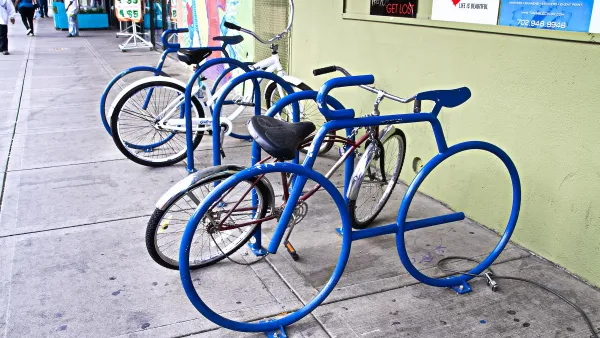
Where's the nearest bike rack? This Las Vegas map shows you.
Because bike parking is often on private property, it's difficult for cyclists to know where they can find it.
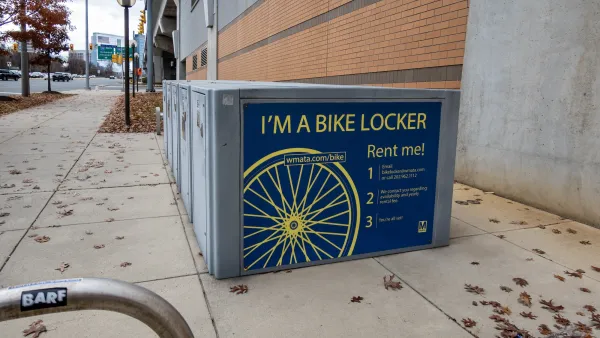
DC is Installing Hundreds of New Bike Lockers at Metro Stops
The WMATA’s push to better integrate bikes into their transit system includes hundreds of new secure bike lockers, repair stations, and train cars with dedicated space for bikes.
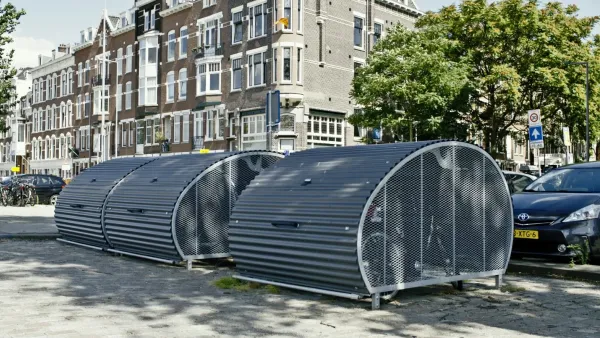
NYC Launches Citywide Secure Bike Parking Network
The new parking hubs will span 500 locations and offer an alternative to taking bikes on crowded transit or up multi-story apartment stairs.

Planetizen Federal Action Tracker
A weekly monitor of how Trump’s orders and actions are impacting planners and planning in America.

California plans to bury El Niño’s downpour
If the state plays its cards right, it may be able to store a billion acre-feet of El Niño’s water in aquifers.

Desperate measures: Advocates weigh draining Lake Powell to fill Colorado River
Draining the reservoir could reduce evaporation losses by a couple hundred thousand acre-feet.

Mamdani’s pied-à-terre tax survives legal challenge
A panel of judges found that the plaintiffs failed to demonstrate injury as a result of New York City's implementation of the tax.

Eastern Nebraska is running out of electricity
Data centers and electrification are straining eastern Nebraska’s grid, throttling economic development.

Seattle passes record-breaking transit services expansion
Proposition 1 will double the city’s transit tax to add 95,000 more bus trips and preserve 180,000 bus trips annually.

FREE Course: Walkable City 1: Why Walkability?
After describing his path towards focusing on walkability as the essence of good planning, Jeff Speck marches through his five principal reasons for making more walkable places.
Reinventing Malls: Planning Alchemy—Turning Gray Fields Into Gold
The course focuses on the opportunities and imperatives that shape reinvention of mall sites.

City of Rosemead
Rutgers University, Edward J. Bloustein School of Planning and Public Policy
One Hundred Miles
University of Michigan School for Environment and Sustainability (SEAS)
Hunter College, City University of New York (CUNY)
The Architects Foundation
City of Cambridge
Montrose County
The Pocatello Development Authority