Michael Kimmelman comes out against the plan to rezone a 73-block area around Grand Central Terminal to allow the replacement of "aging commercial buildings with giant new office towers". The city should focus on planning, not zoning, he argues.


"New York can surely never win a skyscraper race with Shanghai or Singapore," says Kimmelman, in joining the chorus of opponents to the plan to upzone East Midtown. "Its future, including the future of Midtown real estate values, depends on strengthening and expanding what already makes the city a global magnet and model. This means mass transit, pedestrian-friendly streets, social diversity, neighborhoods that don’t shut down after 5 p.m., parks and landmarks like Grand Central Terminal and the Chrysler Building."
"If New York wants to learn from London, Tokyo and Shanghai, the lessons aren’t about erecting new skyscrapers," he continues. "Big cities making gains on New York are investing in rail stations, airports and high-speed trains, while New York rests on the laurels of Grand Central and suffers the 4, 5 and 6 trains, which serve East Midtown."
"The Bloomberg administration has certainly not been tone deaf to place-making during the last dozen years, transforming many city parks, waterfronts and plazas, and embracing sustainable design," he notes. "But its plan for East Midtown fails to recognize a fundamental paradigm shift. The focus in designing cities has now turned from buildings to the spaces between those buildings — sidewalks, plazas, parks — whose disposition requires planning."
Read the full story: The Plan to Swallow Midtown

High-Rise Approval Secures $220 Million for Grand Central Terminal Improvements
In exchange for the approval to build One Vanderbilt, a 63-story office tower adjacent to Grand Central Terminal, the developer will give the MTA $220 million for upgrades to entrances of the Metro-North Railroad and the terminal's subway entrances.
Manhattan Upzoning Stumbles on Way to the Finish Line
NYC's revised plan for rezoning the area known as East Midtown met with a chilly reception from a variety of community and interest groups when unveiled last week. Planners are trying to finalize the controversial plan before Mayor Bloomberg exits.
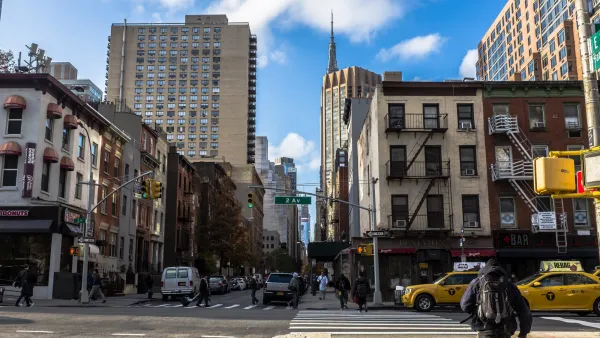
Property Owners Jostle for Deals After Midtown East Rezoning
A flurry of air rights purchases have already begun as large property owners take advantage of Midtown East's upzoning. Some big names include JPMorgan Chase and the Archdiocese of New York.

Planetizen Federal Action Tracker
A weekly monitor of how Trump’s orders and actions are impacting planners and planning in America.

Amtrak, CN end decades-long dispute with eight-year agreement
The new operating agreement establishes an updated framework for the companies to work together, including processes to resolve disputes.

Northwest rail fans eager for Sept. 30 debut of Amtrak’s Airo fleet
Get ready for that new train smell and more seats. But they won’t go faster or run more frequently on the Cascades route in Washington and Oregon.

St. Louis Metro to test if single-car trains can reduce operating costs, maintain rider satisfaction
The pilot program will run from October to spring 2027, and begin with one single-car train operating on Metrolink’s Red and Blue lines.

Pennsylvania is building data centers in abandoned mines
Housing data centers in mines provides an alternative to destroying local forests and may spare residents from data centers’ noise and air pollution.

If Corpus Christi can’t revive desalination plant project, it may owe Texas $235 million
Earlier this month, city officials declined to pursue developing the plant for the second time in a year.

FREE Course: Walkable City 1: Why Walkability?
After describing his path towards focusing on walkability as the essence of good planning, Jeff Speck marches through his five principal reasons for making more walkable places.
Reinventing Malls: Planning Alchemy—Turning Gray Fields Into Gold
The course focuses on the opportunities and imperatives that shape reinvention of mall sites.

City of Thousand Oaks
City of Wisconsin Rapids
Harvard University Graduate School of Design
The Architects Foundation
University of Cincinnati Online
The Pocatello Development Authority
The Urban Renewal Agency of the City of Pocatello