Thanks to mobile technology, Los Angelenos no longer have to choose between driving their own cars and paying expensive cab fares after a night out on the town.


Lyft, Uber, Sidecar, and similar companies connect drivers with riders via smartphone Apps. User feedback suggests that the easy-to-use Apps cut down on drunk driving as well as road congestion, Ian Lovett writes.
Newly-minted Los Angeles Mayor Eric Garcetti has championed the city's move away from its celebrated "culture of car ownership". But many taxi drivers aren’t happy with the App-based ride-share revolution. Last month, three App companies received cease-and-desist orders from the city, but cooperation has been minimal.
Safety is also a concern, at least for L.A.’s taxicab administrator. “I’m honestly worried for the drivers of those companies,” he said. “I have two daughters in their 20s, and I would never let them driver for those companies.”
Read the full story: Where Car Is King, Smartphones May Cut Traffic

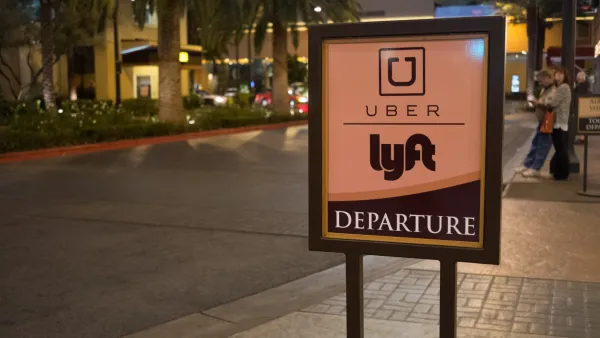
An Uber-Lyft Duopoly Could Benefit Customers
As monopolies, especially local ones, loom in some other industries, Uber's predominance has been slipping. Will a duopoly between Uber and Lyft be enough to ensure quality ride-hailing?
New Study Underway: Do Ride-Hailing Services Reduce Car Ownership?
The University of California, Berkeley and NRDC will team-up to verify whether Uber and Lyft reduce car ownership and are thus good for the environment. Such data already exists for a sister form of shared mobility: car-share.
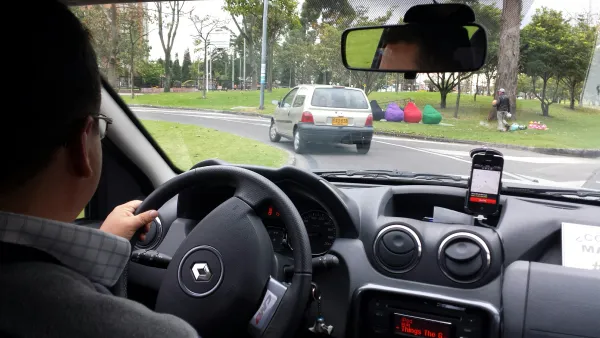
The Ride-Share Revolution
"If the 20th century was devoted to building the infrastructure to service the personal automobile, then perhaps the 21st century will be devoted to undoing most of it."

Planetizen Federal Action Tracker
A weekly monitor of how Trump’s orders and actions are impacting planners and planning in America.

Amtrak, CN end decades-long dispute with eight-year agreement
The new operating agreement establishes an updated framework for the companies to work together, including processes to resolve disputes.

Nation's most wind-powered state turns to coal as data centers increase energy demand
For the first time in decades, Iowa has increased its generation of coal power.

Alabama scores up to $2.5 billion federal loan for largest infrastructure project in state’s history
The Mobile River Bridge and Bayway Project aims to ease congestion at Alabama’s worst bottleneck.

Trump is considering data centers on 6 states' public land — some state officials say they had no idea
If the administration approves the proposed projects, data center and data center-related developments will cover 17,600 acres of public land.

Despite court ruling, Trump is keeping nearly all wind projects in the US on hold
At least 110 wind energy projects have not heard from the government since a federal judge ruled that the Trump administration's freeze on wind turbine clearances was likely illegal.

FREE Course: Walkable City 1: Why Walkability?
After describing his path towards focusing on walkability as the essence of good planning, Jeff Speck marches through his five principal reasons for making more walkable places.
Reinventing Malls: Planning Alchemy—Turning Gray Fields Into Gold
The course focuses on the opportunities and imperatives that shape reinvention of mall sites.

KFH Group Inc.
Greater Baltimore Committee
Eagle County Government
The Architects Foundation
University of Cincinnati Online
The Pocatello Development Authority
The Urban Renewal Agency of the City of Pocatello