Wash. state senate Republicans dealt a crushing blow to governors of both Wash. and Ore. by killing a 10.5-cent gas tax bill needed to tap $850 million in federal funds to finance rebuilding of two, obsolete I-5 spans over the Columbia River.


Politics stymied yet another attempt by a state legislature to increase its gas tax, just as it did in Pennsylvania, both on the final day of their legislative sessions, June 30. Eric Florip writes that "the Washington Senate delivered the fatal blow to the beleaguered [Columbia River Crossing (CRC)] project. Lawmakers turned back a last-ditch effort to push through a transportation revenue package that would have steered crucial funding to the CRC and other projects across the state."
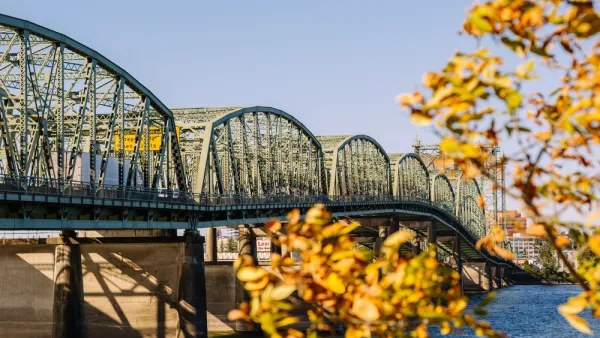
Supporters called the CRC an essential fix for an aging bridge that’s an economic and safety liability. The twin spans of the I-5 bridge were built in 1917 and 1958. Both are considered “functionally obsolete” by state transportation officials.
Gov. Jay Inslee had called a special session on June 11 to pass the crucial transportation package that included the controversial 10.5-cent gas tax. The House passed the bill on June 29. Senate Republicans and two Democrats prevented the bill from being voted on before adjournment.
Gov. Jay Inslee will meet with Oregon Gov. John Kitzhaber and transportation officials to decide next steps... But the assumption all along was that the ($3.4 billion) project would fold if Washington lawmakers made no commitment this year, he said.
It wasn't just the bridge crossing, but transit funding that was at stake. Jordan Schrader of The News Tribune writes in Mass Transit that "Senate leaders declined to consider a House-passed package of fees, taxes and local taxing authority for agencies such as Metro Transit and Pierce Transit. The package was a top priority of Democratic Gov. Jay Inslee..."
The bridge would have included an extension of Portland's light rail to Vancouver, which didn't go over well with Clark County, along with the variable (based on congestion) electronic toll that would apply to all motorists, an essential part of the financing package along with $450 million from both states. Oregon had met their obligation.
Drew Mikkelsen of KING 5 News writes "(t)hat project was set to receive $850 million from the federal government. Inslee said that money may not be available to the state after September 1."
Despite the vastly improved bicycle/ped' component, Bike Portland celebrated the defeat of the transportation bill. "It took Washington Republicans who were suspicious of such a huge government expenditure — especially one that included light rail — to finally kill this thing", wrote Jonathan Maus, its publisher/editor.
Apparently, the collapse of another, functionally obsolete bridge, sixty miles north on I-5 on May 23, sending two vehicles barreling into the Skagit River did not provide the incentive to the Wash. state senate to pass a gas tax to replace the much larger, problem-plagued I-5 bridge over the Columbia River.
Read the full story: UPDATE: CRC meets demise as Legislature adjourns

Skagit "Miracle" Bridge Opens on I-5 in Washington
In this editorial, The News Tribune takes aim at the WA State Department of Transportation - in a complimentary way - at the speed and efficiency in which it handled the collapse of the Skagit River Bridge on May 23. The replacement opened Sept. 15.
Pop Quiz: What State Has Highest Percentage of Deficient Bridges?
Hint: It's also the smallest by area. And the next two on the "first is worst" list are in the Northeast as well. According to 2014 FHWA data, over 50 percent of this state's bridges are considered deficient, either structurally or functionally.
Reviving the Failed Columbia River Crossing to Connect Oregon, Washington
A project is back from the dead in the Pacific Northwest, at least in the eyes of the governors of Oregon and Washington.

Planetizen Federal Action Tracker
A weekly monitor of how Trump’s orders and actions are impacting planners and planning in America.

Amtrak, CN end decades-long dispute with eight-year agreement
The new operating agreement establishes an updated framework for the companies to work together, including processes to resolve disputes.

Judges permit Denver to divert 77,000 acre feet from the Colorado River for reservoir expansion
Overuse and climate change have caused the Colorado River’s water levels to plummet.

Philadelphia to invest $2 billion into upgrading city airports as PHL places last in customer satisfaction
Modernizations to Philadelphia's airports will include baggage system upgrades and a new automated parking garage guidance system.

The LA housing policies making developers turn away from the city
Despite LA’s housing shortage, developers say the city’s "mansion-tax" and pandemic-era policies make it an unappealing place to build housing.

New density bill would require 7 California cities to establish regional transit hubs
The bill would also require major cities in California to permit high-rise residential buildings.

FREE Course: Walkable City 1: Why Walkability?
After describing his path towards focusing on walkability as the essence of good planning, Jeff Speck marches through his five principal reasons for making more walkable places.
Reinventing Malls: Planning Alchemy—Turning Gray Fields Into Gold
The course focuses on the opportunities and imperatives that shape reinvention of mall sites.

City of Wisconsin Rapids
Harvard University Graduate School of Design
KFH Group Inc.
The Architects Foundation
University of Cincinnati Online
The Pocatello Development Authority
The Urban Renewal Agency of the City of Pocatello