A project is back from the dead in the Pacific Northwest, at least in the eyes of the governors of Oregon and Washington.


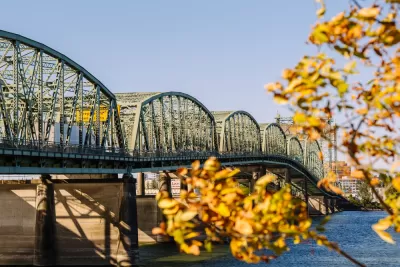
"Gov. Kate Brown wants Oregon to accelerate plans to replace the Interstate Bridge," reported Andrew Theen on April 2.
Governor Brown's words of support followed Washington Governor Jay Inslee calling for $17.5 million in funding to open a new bi-state office to lead design, engineering, and public outreach for the project known as the Columbia River Crossing.
"In a March 20 letter to the chair of the Oregon Transportation Commission, Brown said the aging bridge spanning the Columbia River is 'a seismic risk, a freight bottleneck, a barrier to effective public transportation and a source of some of the worst gridlock in the nation,'" reports Theen.
Later in the week, Theen reported that Governor Brown was suggesting a new name for the project—the Interstate Bridge Replacement (IBR).
The Columbia River Crossing or Interstate Bridge Replacement project recently made news another kind on the Portland region highway project beat, when Joe Cortright discovered the project had factored into the math in an environmental assessment for the proposed I-5 Rose Quarter Improvement Project.
Many of the projected benefits listed in that environmental assessment (e.g., improved air quality, travel times, and traffic safety) assumed that the Columbia River Crossing, long defunct and subject only recently to the speculative political support reported here, would be built.
FULL STORY: Kate Brown: The time to plan new Interstate Bridge is now

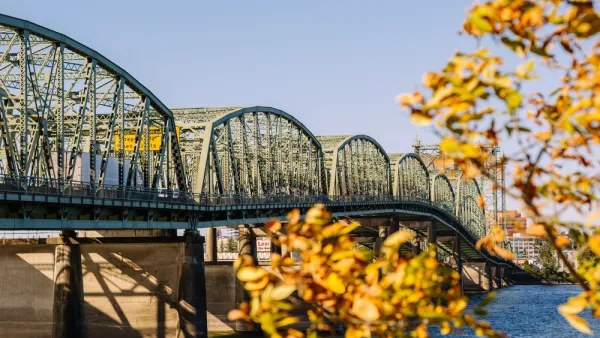
New Hope for the Abandoned I-5 Bridge Project Between Oregon and Washington
The mayor of Vancouver, Washington is leading a goodwill campaign in the hopes of launching work on a new bridge over the Columbia River, after Washington abandoned Oregon on the project in 2013.
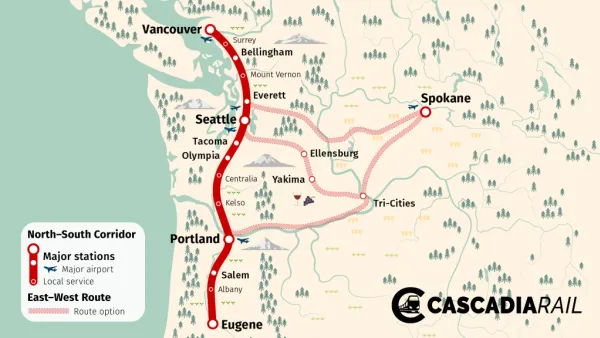
Cascadia High-Speed Rail Corridor Seeking Federal Funding
The state of Washington is hoping federal infrastructure funding can pay for $198 million of the $348 million necessary to plan the Cascadia High-Speed Rail project.
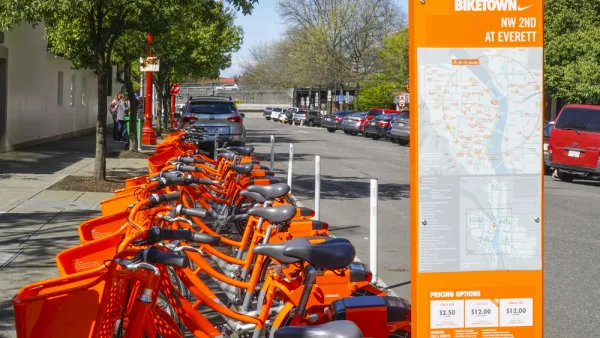
Draft West Portland Town Center Plan Seeks Public Comment
Always a closely watched planning jurisdiction, Portland, Oregon is proceeding with a new vision for the future of the western end of the city.

Planetizen Federal Action Tracker
A weekly monitor of how Trump’s orders and actions are impacting planners and planning in America.

The state-sanctioned urbicide of Austin
People don’t kill cities. Freeways do.

US to reduce Colorado River water deliveries to Mexico
A new Colorado Treaty amendment reduces Mexico’s Colorado River water allocation by 250,000 acre feet.

5 New England states march closer to 800 megawatt wind energy project
Securing federal approval for the project may be complicated under the Trump administration, which has historically been hostile towards domestic wind power.

Baltimore to break ground on $50 million Transit Priority Project
The project will bring faster bus trips, safer streets and better bike connections to Baltimore.

Airbnb launches $250 million 'last-dollar financing' housing accelerator, makes first investment in Austin
The company will put $6.4 million towards affordable housing development in Texas’ capital.

FREE Course: Walkable City 1: Why Walkability?
After describing his path towards focusing on walkability as the essence of good planning, Jeff Speck marches through his five principal reasons for making more walkable places.
Reinventing Malls: Planning Alchemy—Turning Gray Fields Into Gold
The course focuses on the opportunities and imperatives that shape reinvention of mall sites.

Eagle County Government
Harvard University Graduate School of Design
Nashville Planning Department
The Architects Foundation
University of Cincinnati Online
The Pocatello Development Authority
The Urban Renewal Agency of the City of Pocatello
Journal of the American Planning Association