The 12-county downstate commuter tax is vilified by many living outside New York City - forced to pay a payroll tax to support transit that they may not use. They sued the MTA and won last August, but MTA had the ruling reversed on appeal on June 26.


Benjamin Kabak describes the on-going saga (in Second Ave. Sagas, founded in 2006 to track the progress of Manhattan's long-awaited Second Ave. subway) of a vital revenue mechanism for the Metropolitan Transportation Authority that provides transit service - bus, subway, and commuter rail - for the five boroughs of NYC and seven surrounding suburban counties, including funds for the struggling Long Island Bus.
Round I (also reported here) went to Nassau County Executive Edward Mangano on August 22 with a ruling by a single N.Y. Supreme Court justice ruling that the payroll mobility tax (also referred to as the commuter tax) was unconstitutional. On June 26, a four-judge panel of the Appellate Division overturned that ruling, allowing the MTA to continue to collect the vital tax that had been authorized by the state legislature in 2009, accounting for 12% of its annual budget
The PMT, a 34-cent tax on every $100 of payroll paid by public and private employers in the 12-county MTA region, generates $1.2 billion annually. (Streetsblog, 2012)
Kabak questions the wisdom of using the courts to strike down the tax, offering an alternative venue for such efforts.
In Albany, efforts to repeal or pare down the payroll tax will continue, but that’s the right approach. A legislative response is now required, and the payroll tax, imperfect but necessary, lives on as a permissible, constitutional exercise of legislative power that clearly serves a substantial state interest.
On June 28, Kabak writes that "Nassau County isn’t giving up. The Long Island plaintiffs will appeal this week’s decision to the Court of Appeals, the highest state court in New York’s judiciary system, Newsday reported today.
Kabak adds that "it seems that Nassau County Executive Edward Mangano is content to spend more taxpayer dollars pursuing a lawsuit he has no chance of winning." Without commenting on his chance of winning, we noted here that while Nassau may be a wealthy county, under Mangano's leadership the county found itself in dire financial straights just two years ago.
From the suburbs north of NYC, Mid-Hudson News Network writes "several upstate municipalities and the Orange County Chamber of Commerce were among those joining the Nassau County lawsuit challenging the tax. Nassau paid all of the legal fees."
Orange chamber President John D’Ambrosio said he is disappointed with the ruling but is not giving up the fight to have the tax revoked. He said the business community will continue to lobby state lawmakers in Albany to eliminate it.
To sum up, Round I went to the suburbs; Round II went to MTA, and Round III just began. Stay tuned.
Read the full story: On appeal, NY state court OKs MTA payroll tax

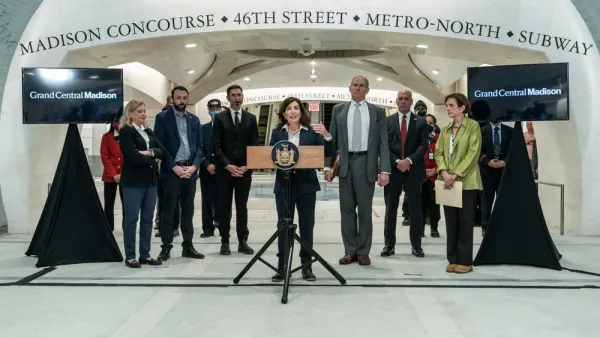
Long Island Rail Now Connects to Grand Central Terminal
A new rail service launched this week could save commuters as much as 40 minutes on trips between Long Island and Manhattan.
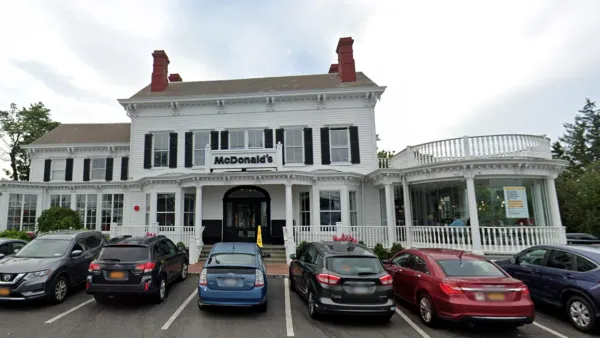
America's 'Most Beautiful McDonald's'?
The Long Island restaurant is housed in a historic 18th century farmhouse.
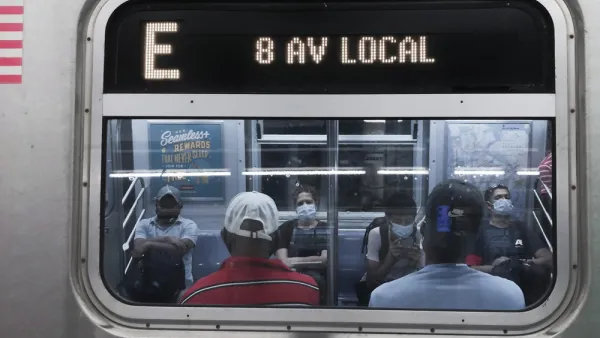
Report: New York MTA Facing 'Greatest Crisis' in its History
A new report on the finances of the New York Metropolitan Transportation Authority (MTA) makes a desperate plea for assistance from the federal government.

Planetizen Federal Action Tracker
A weekly monitor of how Trump’s orders and actions are impacting planners and planning in America.

Amtrak, CN end decades-long dispute with eight-year agreement
The new operating agreement establishes an updated framework for the companies to work together, including processes to resolve disputes.

Judges permit Denver to divert 77,000 acre feet from the Colorado River for reservoir expansion
Overuse and climate change have caused the Colorado River’s water levels to plummet.

NYC DOT wants faster, more permanent street upgrades
The city is examining ways to build more concrete infrastructure without getting entangled in 'decades-long' projects.

'Something we’ve never seen before:' rising utility rates could strain city finances nationwide
Data centers, climate change and other factors have caused utility rates in the United States to increase by 38% since 2020.

Trump to overrule local leaders, lease millions of acres of America’s Pacific Island territories’ seafloors to mining companies
International law says that the Indigenous people of America’s territories have a right to prior and informed consent regarding projects that impact their countries.

FREE Course: Walkable City 1: Why Walkability?
After describing his path towards focusing on walkability as the essence of good planning, Jeff Speck marches through his five principal reasons for making more walkable places.
Reinventing Malls: Planning Alchemy—Turning Gray Fields Into Gold
The course focuses on the opportunities and imperatives that shape reinvention of mall sites.

Harvard University Graduate School of Design
KFH Group Inc.
Greater Baltimore Committee
The Architects Foundation
University of Cincinnati Online
The Pocatello Development Authority
The Urban Renewal Agency of the City of Pocatello