This week, a New York Supreme Court Justice declared unconstitutional a tax covering a 12-county area including the city of New York and its surrounding suburbs, creating a $1.26 billion hole in this year's MTA budget.


In ruling in favor of a lawsuit brought by Nassau County Executive Edward Mangano and other suburban communities against the Payroll Mobility Tax, which was adopted by the State Legislature in 2009 to rescue the indebted Metropolitan Transportation
Authority (MTA), "Judge R. Bruce Cozzens Jr. held the levy violated a so-
called home-rule provision in the state constitution," reports Esmé E. Deprez.
In a statement, the MTA claimed that, "Removing
more than $1.2 billion in revenue from the Payroll Mobility Tax,
plus hundreds of millions of dollars more from other taxes
affected by yesterday's ruling, would be catastrophic for the
MTA and for the economy of New York state." It continues, "Without the Payroll Mobility Tax or another stable and reliable
source of funding, the MTA would be forced to implement a combination of
extreme service cuts and fare hikes."
According to Deprez, "Mangano, a Republican who led the plaintiffs in the suit
filed in 2010, celebrated today alongside state and county
legislators at a news briefing in Mineola. He called the
decision as a 'victory for taxpayers and job creators
throughout the state.'"
Read the full story: New York MTA’s Payroll Tax Rejected in Blow to Agency
MTA Commuter Tax Pits New York City Against Suburbs
The 12-county downstate commuter tax is vilified by many living outside New York City - forced to pay a payroll tax to support transit that they may not use. They sued the MTA and won last August, but MTA had the ruling reversed on appeal on June 26.

New York Officials Back Down on Bus Lane Plans
Proposed bus improvements in the Bronx are the latest casualty of opposition.
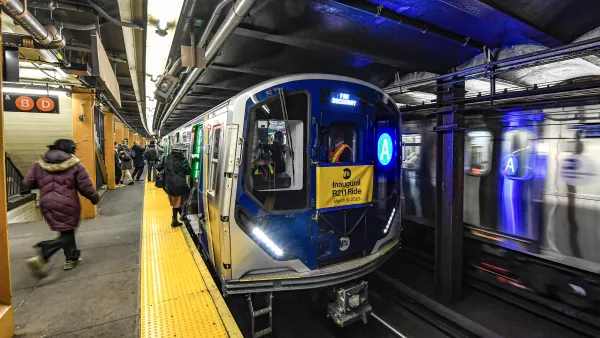
Fancy New Subway Cars Join the New York Subway System
New York has been planning on adding these new subway cars for years, finally achieving their goal in March 2023. More than a thousand of the new R211 trains will be running in New York within two years if all goes according to plan.

Planetizen Federal Action Tracker
A weekly monitor of how Trump’s orders and actions are impacting planners and planning in America.

California plans to bury El Niño’s downpour
If the state plays its cards right, it may be able to store a billion acre-feet of El Niño’s water in aquifers.

Desperate measures: Advocates weigh draining Lake Powell to fill Colorado River
Draining the reservoir could reduce evaporation losses by a couple hundred thousand acre-feet.

Los Angeles just elected an urban planner as its mayor
Transportation analysts are optimistic that Raman will be more aggressive in addressing transit issues than Bass.

Mamdani’s pied-à-terre tax survives legal challenge
A panel of judges found that the plaintiffs failed to demonstrate injury as a result of New York City's implementation of the tax.

Eastern Nebraska is running out of electricity
Data centers and electrification are straining eastern Nebraska’s grid, throttling economic development.

FREE Course: Walkable City 1: Why Walkability?
After describing his path towards focusing on walkability as the essence of good planning, Jeff Speck marches through his five principal reasons for making more walkable places.
Reinventing Malls: Planning Alchemy—Turning Gray Fields Into Gold
The course focuses on the opportunities and imperatives that shape reinvention of mall sites.

City of Rosemead
Rutgers University, Edward J. Bloustein School of Planning and Public Policy
One Hundred Miles
University of Michigan School for Environment and Sustainability (SEAS)
Hunter College, City University of New York (CUNY)
The Architects Foundation
City of Cambridge
Montrose County
The Pocatello Development Authority