The centerpiece of a $500 million plan for redeveloping New Orleans' riverfront is an 'iconic' sculpture, replacing the empty World Trade Center tower. Roberta Brandes Gratz argues the city should focus on small steps instead of a tourism boondoggle.


"In his mid-April rollout of a sweeping plan to redevelop the downtown riverfront, Mayor Mitch Landrieu spoke excitedly of replacing the World Trade Center at the foot of Canal Street with a monumental tourist attraction — something, he said, on a par with the Gateway Arch in St. Louis," writes Gratz. "A bit of education might dissuade the mayor from collapsing into the arms of that old-time and now thoroughly discredited style of 'urban renewal.'”
In the ensuing opinion piece, she provides a cautionary tale of the unfulfilled economic promises delivered by the St. Louis landmark, and describes the lessons for New Orleans.
"First, New Orleans does not need an iconic sculpture on the waterfront, even assuming it could land one as beautiful as Saarinen’s arch," she argues. "The French Quarter and the larger city itself are all the iconic attraction the city needs. No other American city has what New Orleans already has, having evolved organically, the only way authentic cities grow."
"[W]hile advocates of big projects focus on outsized, misguided visions, New Orleans is rebounding incrementally through innovative efforts all over town, proving once again that small and modest projects always exceed expectations while the big ones never fulfill theirs."
Read the full story: Monumental mistake: Demolishing World Trade Center to build a tourist attraction


The Uncertain Future of the St. Louis Loop Trolley
St. Louis faces losing federal funds if the Loop Trolley remains defunct. But is the 2.2-mile line worth it?
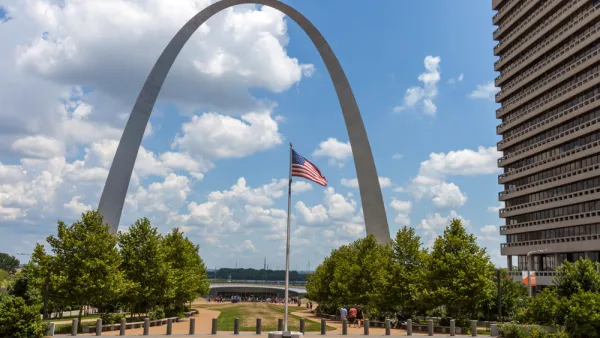
Newly Minted St. Louis Gateway Arch National Park Reviewed
The recently revitalized and designated as a National Park St. Louis Gateway Arch National Park is described by park planner Clement Lau.
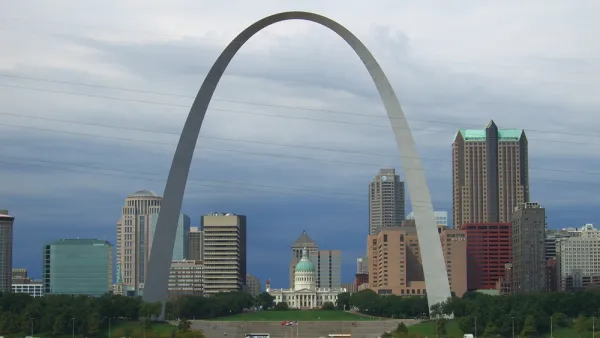
Design Review: Revamped Gateway Arch an Urban Success
Pulitzer Prize-winning critic Blair Kamin assesses the remodeled Gateway Arch in St. Louis, prior to its big public opening on July 3.

Planetizen Federal Action Tracker
A weekly monitor of how Trump’s orders and actions are impacting planners and planning in America.

Amtrak, CN end decades-long dispute with eight-year agreement
The new operating agreement establishes an updated framework for the companies to work together, including processes to resolve disputes.

Northwest rail fans eager for Sept. 30 debut of Amtrak’s Airo fleet
Get ready for that new train smell and more seats. But they won’t go faster or run more frequently on the Cascades route in Washington and Oregon.

St. Louis Metro to test if single-car trains can reduce operating costs, maintain rider satisfaction
The pilot program will run from October to spring 2027, and begin with one single-car train operating on Metrolink’s Red and Blue lines.

Pennsylvania is building data centers in abandoned mines
Housing data centers in mines provides an alternative to destroying local forests and may spare residents from data centers’ noise and air pollution.

If Corpus Christi can’t revive desalination plant project, it may owe Texas $235 million
Earlier this month, city officials declined to pursue developing the plant for the second time in a year.

FREE Course: Walkable City 1: Why Walkability?
After describing his path towards focusing on walkability as the essence of good planning, Jeff Speck marches through his five principal reasons for making more walkable places.
Reinventing Malls: Planning Alchemy—Turning Gray Fields Into Gold
The course focuses on the opportunities and imperatives that shape reinvention of mall sites.

City of Thousand Oaks
City of Wisconsin Rapids
Harvard University Graduate School of Design
The Architects Foundation
University of Cincinnati Online
The Pocatello Development Authority
The Urban Renewal Agency of the City of Pocatello