Downtown Redwood City (near San Francisco) has seen an amazing turnaround due to an aggressive program of code reform, strong investments in public spaces, and a strategy of using entertainment as a catalyzing force.


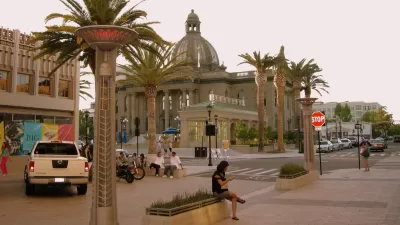
Founded in 1852 as a port on a creek leading to San Francisco Bay, Redwood City took its name from the redwood lumber that was shipped from there to build Gold Rush-era San Francisco. It became one of the primary towns on the San Francisco Peninsula and had a strong downtown until the middle of the 20th century.
As with so many American downtowns, it declined with construction of nearby malls and other shopping centers. A redevelopment plan was drawn up in the 1960s to completely demolish historic districts, create superblocks, and pedestrianize primary streets. Thankfully, this plan was never implemented, and Downtown Redwood City limped through the late 20th century struggling economically, but physically intact.
The citizens of Redwood City had long desired for their Downtown to be revitalized, and steadily demanded that actions be taken to improve the area. The turnaround really began in earnest at the turn of the millennium and is now a juggernaut with more housing currently under way than was constructed in the previous five decades combined.
Read the full story: CITY SPOTLIGHT: The New Urbanist Renaissance of Downtown Redwood City

How the Post-Covid Reality Is Reshaping Central Business Districts and Urban Centers
U.S. cities are working to redefine their downtowns in response to the “donut effect:” people and businesses abandoning city centers and flocking to suburban areas and beyond.
Houston Area's Center of Gravity Shifts Outside the Loop
The population center of Harris County is now outside central Houston, a shift that occurred over the last two decades as the region's suburbs blossomed.
Reimagining San Francisco for the Post-COVID Era
A San Francisco nonprofit is developing a set of recommendations for making downtown neighborhoods more flexible and welcoming to a more diverse set of users.

Planetizen Federal Action Tracker
A weekly monitor of how Trump’s orders and actions are impacting planners and planning in America.

Northwest rail fans eager for Sept. 30 debut of Amtrak’s Airo fleet
Get ready for that new train smell and more seats. But they won’t go faster or run more frequently on the Cascades route in Washington and Oregon.
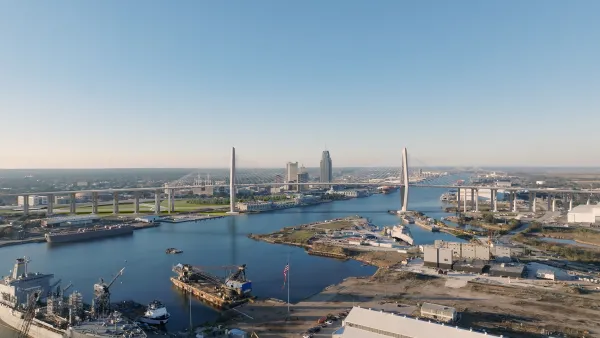
Alabama scores up to $2.5 billion federal loan for largest infrastructure project in state’s history
The Mobile River Bridge and Bayway Project aims to ease congestion at Alabama’s worst bottleneck.

Novel study finds extreme state-by-state disparity in housing construction timelines
The first comprehensive working paper on U.S. construction timelines also found that the permitting process for multi-family projects has slowed nationwide.

California may destroy its beaches trying to save homes from El Niño
Boulders and seawalls can protect homes from waves, but ultimately destroy sandy beaches.

California high-speed rail accomplishes only one legislative goal in 2026
The majority of the agency's failed pitches were never developed into written proposals.

FREE Course: Walkable City 1: Why Walkability?
After describing his path towards focusing on walkability as the essence of good planning, Jeff Speck marches through his five principal reasons for making more walkable places.
Reinventing Malls: Planning Alchemy—Turning Gray Fields Into Gold
The course focuses on the opportunities and imperatives that shape reinvention of mall sites.

City of Thousand Oaks
City of Wisconsin Rapids
Harvard University Graduate School of Design
The Architects Foundation
University of Cincinnati Online
Northern Illinois Transit Authority (NITA)
The Pocatello Development Authority
The Urban Renewal Agency of the City of Pocatello