Jay Corbalis profiles NoMa (short for “North of Massachusetts Avenue”), Washington D.C.'s fastest growing neighborhood, where a building boom has been propelled by an innovative transit funding partnership between the public and private sectors.


"Fifteen years ago, the NoMa of today would have been difficult to imagine," says Corbalis. "Despite its proximity to Union Station and the U.S. Capitol, the area (roughly bounded by Massachusetts Avenue, North Capitol Street, Florida Avenue and 3rd street NE) was home to an uninspired collection of vacant lots, surface parking and low-slung warehouses."
"It wasn’t until the City teamed with local property owners and the federal government to construct a new Metro station that the area began its rapid transformation into one of the city’s most dynamic neighborhoods. Since then, the neighborhood has become a poster child for successful transit-oriented development, while providing a model for communities across the country looking to take advantage of a changing real estate market in a time of constrained public budgets."
FULL STORY: Development-oriented transit: How value-capture launched DC’s newest neighborhood


Op-Ed: Transportation Assets Should Generate Revenue
Scott Rawlins argues that public-private partnerships could help transportation departments turn assets into income streams. Underutilized land and data are two areas of interest.
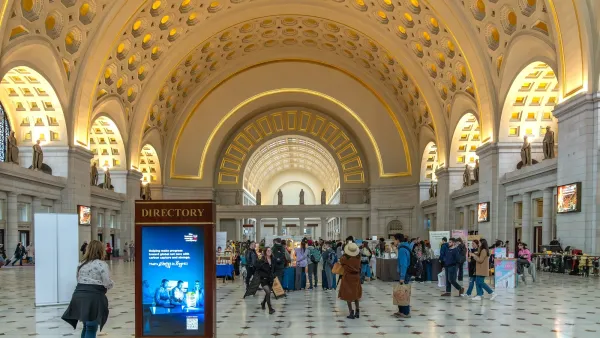
USDOT abandons $8.8B DC Union Station expansion plan to seek private funding
The Trump administration is withdrawing a proposed redesign, offering $24 million to support efforts to bring in private investment.

Texas, California Rail Projects Seek Out Private Funding
In the wake of Trump’s cuts to high-speed rail projects, rail authorities are looking to private-public partnerships to supplement their budgets.

Planetizen Federal Action Tracker
A weekly monitor of how Trump’s orders and actions are impacting planners and planning in America.

The state-sanctioned urbicide of Austin
People don’t kill cities. Freeways do.

US to reduce Colorado River water deliveries to Mexico
A new Colorado Treaty amendment reduces Mexico’s Colorado River water allocation by 250,000 acre feet.

5 New England states march closer to 800 megawatt wind energy project
Securing federal approval for the project may be complicated under the Trump administration, which has historically been hostile towards domestic wind power.

Baltimore to break ground on $50 million Transit Priority Project
The project will bring faster bus trips, safer streets and better bike connections to Baltimore.

Airbnb launches $250 million 'last-dollar financing' housing accelerator, makes first investment in Austin
The company will put $6.4 million towards affordable housing development in Texas’ capital.

FREE Course: Walkable City 1: Why Walkability?
After describing his path towards focusing on walkability as the essence of good planning, Jeff Speck marches through his five principal reasons for making more walkable places.
Reinventing Malls: Planning Alchemy—Turning Gray Fields Into Gold
The course focuses on the opportunities and imperatives that shape reinvention of mall sites.

Eagle County Government
Harvard University Graduate School of Design
Nashville Planning Department
The Architects Foundation
University of Cincinnati Online
The Pocatello Development Authority
The Urban Renewal Agency of the City of Pocatello
Journal of the American Planning Association