While the middle class sought the refuge in the suburbs in the 1960s and 1970s, it turns out that the crime they were fleeing had nothing to do with density, race, or even blight. Mother Jones magazine suggest that it was all because of lead.



Sometimes we find out that all of our work was for naught, having used sabers to battle enemies who carry assault rifles under their cloaks. As it turns out, planners have been wrestling with trip counts and floor-to-area ratios while an errantchemical compound has eaten away at our cities.
In 1999, Freakonomics made passing reference to the correlation between levels of lead pollution and crime, a claim that was quickly forgotten. Mother Jones magazine is renowned for its investigative reporting. If ever a story was hiding in plain sight, it was this one.
Reporter Kevin Drum recently revealed lead for what it was: one of the keys to the epidemic of American crime and violence that ruined our cities in the mid-20th century. It turns out that infants and children exposed to lead can suffer brain damage—usually only slight. A few IQ points, perhaps. Some of the most profound effects, though, of teething on lead-infused cribs, ingesting chips of old paint, and, of course, breathing the fumes of Sky Chief, circa 1965, is that the brain tends toward aggression.
In other words, lead did to America’s children what DDT did to baby birds.
The data curves between levels of ambient lead contamination and incidence of crime—controlled for confounding variables and shifted 20 years, so the criminals in one graph line up with the infants in the other—match up almost perfectly. The implications for moral philosophy are profound: humans are not as inherently evil as 20th century Americans might otherwise have assumed.
"If you add a lag time of 23 years," writes Drum, "lead emissions from automobiles explain 90 percent of the variation in violent crime in America. Toddlers who ingested high levels of lead in the '40s and '50s really were more likely to become violent criminals in the '60s, '70s, and '80s." Drum reports that since 1993, rates of rape, assualt, robbery, and murder have all dropped nationwide between 17 and 49 percent. Violent crime in New York City is down 75 percent. And that's not because would-be criminals were scared off by Crockett and Tubbs.
Even so, the United States still has the highest incarceration rate in the world, at roungly 0.7 percent of the population. Harvard sociologist Bruce Western calls this "a level of imprisonment so vast that it forges the collective experience of an entire social group.” Only eight other countries come close. We have 41,000 convicts serving life sentences; the United Kingdom has 41. (Just take a moment to be astonished by those stats.)
"We can either attack crime at its root by getting rid of the remaining lead in our environment," writes Drum. "Or we can continue our current policy of waiting 20 years and then locking up all the lead-poisoned kids who have turned into criminals."
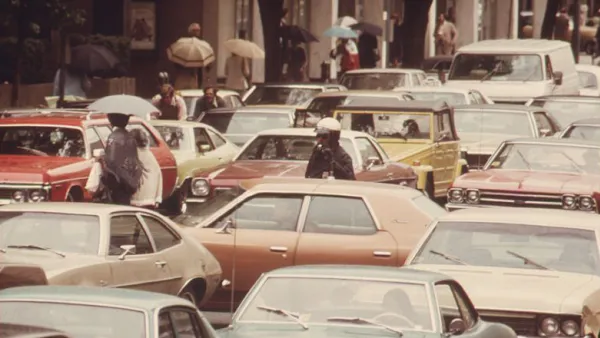
As with almost everything in urban planning, problems and solutions share the same street corner. Urban reformers of the mid-20th century credited density for leading to the crime, deprivation, and decay that inspired suburban flight. As it turns out, population density had nothing to do with it. And vehicular density everything to do with it.
Rivers of cars produced and the invisible haze of lead that poisoned our nation. My own memories portray the 1970s like the brutal cousin of the Jazz Age, mesmerizing for its decrepitude: riots, public housing, disco, and the burning of the Bronx.
If only President Ford had told the city to drop lead instead of drop dead.
Typically, urban planners wisely stay away from public safety, except perhaps as an unwritten footnote in some hopeful plan in which burglars don’t pry open every window and the charming spaces they’d like to create don’t provide cover for an even darker class. As it turns out, the spaces have little to do with it.
It seems to me that the only way to account for the two generations of inner city youth whom we lost and the half-century of fear in which we lived under is to shed our fear—instantly, right now—and rebuild for the better. The Lead Age, such as it was, created a vicious cycle: violence begat violence, fear begat flight, flight begat abandoned cities, and abandoned cities created a rational motivation for crime where once only chemical imbalance had ruled the day. A virtuous cycle can replace the vicious one. The collective bloodstream is being diluted of its poison. We can roar back to the cities—as younger Americans have already been doing—and with that we can seek new means of prospering. We can start by spending losing less money to crime and less emotional energy to fear.
I would never remotely suggest that lead has caused all urban problems, that reinvigorated cities can solve all of them, or that planning alone can eliminate crime (though dense European cities are remarkably crime-free). The complexity of these causes and solutions would dazzle even the most learned chemist. But sometimes policy and economics both operate on the margins. We may never know how tall buildings “should” be or how often a bus line ought to run. But we know that lead is bad and we know that it is, slowly, fading away. We also know that density is good, and that it is on the rise.
From this realization we can derive an estimable amount of hope. Let us leave the urban fringe to the lunatic fringe: to the Tea Partiers and gun nuts whose entire existence is based on distrust and denial that, ultimately, this little, 4 billion year-old planet isn’t big enough for us not to rub elbows with each other.
Let the rest of us go full bore with building better cities, cities based on hope, neighborliness, and the irrefutable fact that prosperity and happiness require the presence of other people. Let us have faith that, when Americans are all in their right minds, a little elbow-rubbing will not hurt anyone. Let us build cities for black and white, rich and poor, believers and atheists, aesthetes and slobs.
And let us no longer build them for leaded and unleaded.

An Astounding Explanation for Why Big Cities Are More Dangerous Than Small Ones
For decades, researchers have hunted for an explanation for why big cities have been more prone to violent crime than small ones. A new hypothesis may offer a surprising answer, and prove that big cities aren't inherently much more dangerous.

How urban design can deter crime
Well-designed public spaces and good lighting can prevent crime and make residents feel safer.
Philadelphia sees 29% drop in gun violence near new green spaces
A city-backed program that cleans up blighted and vacant lots is creating new public spaces and reducing crime in surrounding communities.

Planetizen Federal Action Tracker
A weekly monitor of how Trump’s orders and actions are impacting planners and planning in America.

Amtrak, CN end decades-long dispute with eight-year agreement
The new operating agreement establishes an updated framework for the companies to work together, including processes to resolve disputes.

Judges permit Denver to divert 77,000 acre feet from the Colorado River for reservoir expansion
Overuse and climate change have caused the Colorado River’s water levels to plummet.

Atlanta City Council unanimously backs $3.5 billion Beltline light rail project
The resolution was drafted after Atlanta Mayor Andre Dickens pulled support for the Atlanta Streetcar extension last year.

SEPTA to bring nearby frequent transit to over 1 million new riders as part of decade-long plan
The agency's Accelerate plan will also bring frequent transit to twice the amount of jobs that are currently located near it.

NYC plants over 18,000 trees, the most new foliage in a decade
Many of the trees were planted in communities vulnerable to extreme heat.

FREE Course: Walkable City 1: Why Walkability?
After describing his path towards focusing on walkability as the essence of good planning, Jeff Speck marches through his five principal reasons for making more walkable places.
Reinventing Malls: Planning Alchemy—Turning Gray Fields Into Gold
The course focuses on the opportunities and imperatives that shape reinvention of mall sites.

City of Thousand Oaks
City of Wisconsin Rapids
Harvard University Graduate School of Design
The Architects Foundation
University of Cincinnati Online
The Pocatello Development Authority
The Urban Renewal Agency of the City of Pocatello

