At a raucous community meeting held last week, the opposition to a proposal to replace curbside parking along Polk Street with bike lanes and parklets made their opinions known to city planners, reports Maria L. La Ganga.


San Francisco's Polk Street, where a planned street redesign would replace curbside parking with bicycle, transit, and pedestrian amenities, has become ground zero for debates over the city's efforts to reduce residents' reliance on automobiles.
"To urban planners and bicycle enthusiasts, Polk Street is a key to San Francisco's 4-decade-old 'transit-first' policy, designed to reduce the reliance on private cars in the second-most-densely populated city in the U.S.," explains La Ganga. "But to the more than 300 vocal denizens of Polk Gulch, who packed a standing-room-only neighborhood meeting last week, the proposal is a commerce killer, one that would create 'a freeway for bikes,' with little benefit to shops along the route."
"The agenda is that they really want to get rid of cars," Velvet Da Vinci co-owner Mike Holmes said. "There's no better way of doing that than making sure there [is] no place to park.… This is social engineering on a really crazy scale."
Read the full story: In S.F., an uphill battle for a 'freeway for bikes'
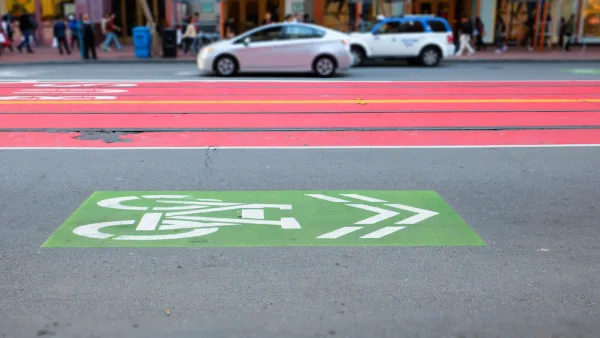
San Francisco's Raised Bike Lanes Fail to…Rise
Citing problems with the raised lanes on Market Street, the city walks back plan for raised bike lane on Polk.
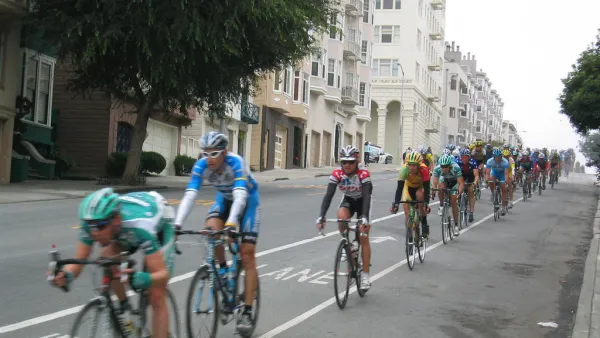
America's Best Bike Lane May Finally Earn the Title
The San Francisco Municipal Transportation Agency voted 6-0 on March 3 to approve a controversial plan to redesign 1.3 miles of Polk Street, one of the most dangerous corridors for biking and walking in The City. It only took 2.5 years.
Is America's Best Bike Lane Overrated?
The SF Examiner reports on America's top-rated bike lane, as rated by People for Bikes. The protected contraflow lane runs from Market Street to Grove Street, all of two blocks; only one block in opposite direction is separated

Planetizen Federal Action Tracker
A weekly monitor of how Trump’s orders and actions are impacting planners and planning in America.

California plans to bury El Niño’s downpour
If the state plays its cards right, it may be able to store a billion acre-feet of El Niño’s water in aquifers.

Desperate measures: Advocates weigh draining Lake Powell to fill Colorado River
Draining the reservoir could reduce evaporation losses by a couple hundred thousand acre-feet.

Seattle passes record-breaking transit services expansion
Proposition 1 will double the city’s transit tax to add 95,000 more bus trips and preserve 180,000 bus trips annually.

Post election, Texas is no longer Musk’s 'AI oasis'
Elon Musk dolled out $446 million on the 2026 midterms, the most ever spent by a non-canidate.

Chicago voters approve permanent festival grounds, penalty for vacant property owners
Currently, major summer and fall festivals take over public parks for weeks at a time, drawing criticism from nearby residents

FREE Course: Walkable City 1: Why Walkability?
After describing his path towards focusing on walkability as the essence of good planning, Jeff Speck marches through his five principal reasons for making more walkable places.
Reinventing Malls: Planning Alchemy—Turning Gray Fields Into Gold
The course focuses on the opportunities and imperatives that shape reinvention of mall sites.

City of Rosemead
Rutgers University, Edward J. Bloustein School of Planning and Public Policy
One Hundred Miles
Hunter College, City University of New York (CUNY)
The Architects Foundation
University of Cincinnati Online
City of Cambridge
Montrose County
The Pocatello Development Authority