Montgomery County, Maryland is confronting a conundrum common to inner-ring suburbs now facing development pressures. How to make the case for protecting mid-century buildings that some consider too young, or "too plain or ugly," to preserve.


Katherine Shaver looks at the efforts of Montgomery County to catalog its mid-century-modern building stock, in the face of redevelopment pressures and the appeal of neo-traditional style developments. The Washington, DC suburb is stepping up its efforts to preserve its recent past by setting up a database - “Montgomery Modern” - of the area's significant buildings and subdivisions from the late 1940s through the early 1960s.
“The challenge is always preserving the recent past,” Clare Lise Kelly, a historic-preservation planner for Montgomery County, said. “It’s easy to look at things from 100 years ago and see them as historic. . . . If we don’t act now to assess resources from this time period, they’ll be gone, and then it’s too late to say, ‘That apartment complex was really special.’ ”
"Kelly said she realizes that some people consider modernist buildings too young — and, in some cases, too plain or ugly — to warrant protection," writes Shaver. "It’s not about age or looks, she said. It’s about preserving critical pieces of architectural history from the post-World War II population and building boom that transformed suburbs such as Montgomery from rural bedroom communities into dense subdivisions and commercial districts."
Thanks to Bora Mici
Read the full story: Montgomery's 'Mad Men' Modern buildings - are they worth protecting?

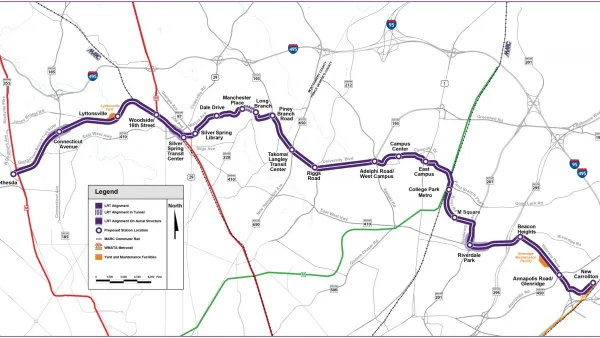
Suburban Maryland Streets Need Pedestrian Improvements for Purple Line Riders
Montgomery County planners recommend the implementation of sidewalks, crosswalks, and bike lanes on streets within a half-mile radius of Purple Line light-rail stations.
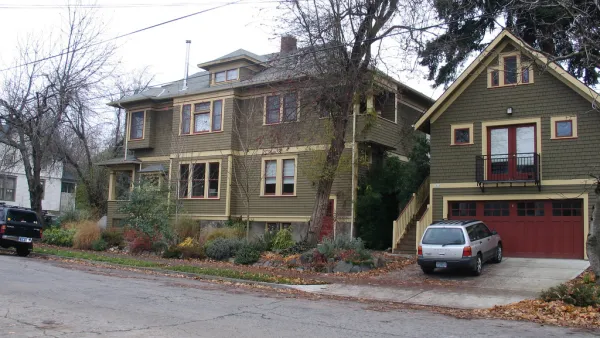
Making the Case for ADUs and Housing Equity
For Montgomery County in Maryland, accessory dwelling units are a viable strategy to help ease the affordable housing crisis.
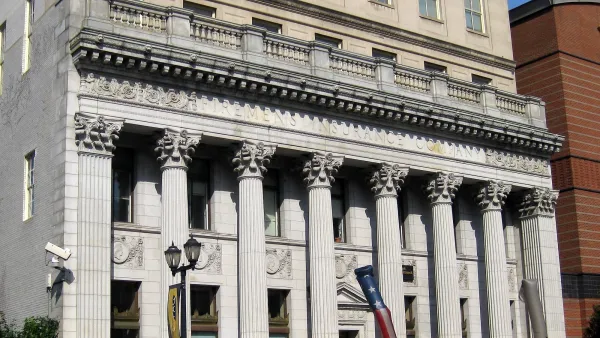
Historic Newark building to become affordable housing
The century-old building will be converted into nearly 200 homes with ground-floor retail.

Planetizen Federal Action Tracker
A weekly monitor of how Trump’s orders and actions are impacting planners and planning in America.

Amtrak, CN end decades-long dispute with eight-year agreement
The new operating agreement establishes an updated framework for the companies to work together, including processes to resolve disputes.

Judges permit Denver to divert 77,000 acre feet from the Colorado River for reservoir expansion
Overuse and climate change have caused the Colorado River’s water levels to plummet.

NYC DOT wants faster, more permanent street upgrades
The city is examining ways to build more concrete infrastructure without getting entangled in 'decades-long' projects.

'Something we’ve never seen before:' rising utility rates could strain city finances nationwide
Data centers, climate change and other factors have caused utility rates in the United States to increase by 38% since 2020.

Trump to overrule local leaders, lease millions of acres of America’s Pacific Island territories’ seafloors to mining companies
International law says that the Indigenous people of America’s territories have a right to prior and informed consent regarding projects that impact their countries.

FREE Course: Walkable City 1: Why Walkability?
After describing his path towards focusing on walkability as the essence of good planning, Jeff Speck marches through his five principal reasons for making more walkable places.
Reinventing Malls: Planning Alchemy—Turning Gray Fields Into Gold
The course focuses on the opportunities and imperatives that shape reinvention of mall sites.

Harvard University Graduate School of Design
KFH Group Inc.
Greater Baltimore Committee
The Architects Foundation
University of Cincinnati Online
The Pocatello Development Authority
The Urban Renewal Agency of the City of Pocatello