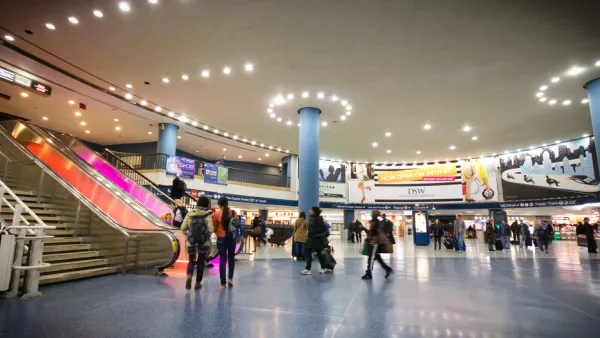
The owners of Madison Square Garden are asking NYC "to renew — in perpetuity — the special permit that allows them to operate an arena atop Penn Station, the country’s busiest transit hub." Michael Kimmelman urges the city to deny their request.


Madison Square Garden, Kimmelman has argued before, is one of the main obstacles to renovating Penn Station in a manner befitting the busiest train station in the United States. Rather than approving the arena's special permit in perpetuity, he suggests that, "[t]he [City] Council could grant a 10-year permit, enough time so that the Garden and the various parties responsible for the station can come up with an appropriately aggressive plan to improve the site, a plan that should include discussions about a possible future home, elsewhere, for the arena."
"Penn Station was designed half a century ago when some 200,000 riders a day used it, but now 650,000 do, and that number is growing. With the Garden on top of it, relief is not likely. The City Planning Commission, which recommended the demolition in 1963 of the old Penn Station, now has, for the first time since then, a chance to atone by giving the permit a time limit. The permit that has just expired was for 50 years."
Although the Garden's owners are investing a billion dollars into upgrading the arena, Kimmelman thinks that after a decade of wear and tear they'll be ready to "build what the Garden should be, the newest and best sports and entertainment facility in the city: an architectural landmark as opposed to an eyesore, lately made to look even worse by the arrival of the spanking new and striking Barclays Center in Brooklyn."
Read the full story: Remember, City Council, Forever Is a Really Long Time


Historic Preservation Appeal Could Delay Penn Station Redevelopment
New York State's Historic Preservation Office has moved to place the notorious Penn Station on the National Register of Historic Places, potentially upending redevelopment plans.

In New York's Next Penn Station, Function Does Not Always Follow Form
Some of the time and money invested in the visually spectacular Moynihan Station should have been spent looking at how well it actually works for commuters, writes Alon Levy.
Cuomo Has a Unique Opportunity with Penn Station
The disastrous state of the country's most busy transit station presents an opportunity to make big improvements.

Planetizen Federal Action Tracker
A weekly monitor of how Trump’s orders and actions are impacting planners and planning in America.

Amtrak, CN end decades-long dispute with eight-year agreement
The new operating agreement establishes an updated framework for the companies to work together, including processes to resolve disputes.

Judges permit Denver to divert 77,000 acre feet from the Colorado River for reservoir expansion
Overuse and climate change have caused the Colorado River’s water levels to plummet.

NYC DOT wants faster, more permanent street upgrades
The city is examining ways to build more concrete infrastructure without getting entangled in 'decades-long' projects.

'Something we’ve never seen before:' rising utility rates could strain city finances nationwide
Data centers, climate change and other factors have caused utility rates in the United States to increase by 38% since 2020.

Trump to overrule local leaders, lease millions of acres of America’s Pacific Island territories’ seafloors to mining companies
International law says that the Indigenous people of America’s territories have a right to prior and informed consent regarding projects that impact their countries.

FREE Course: Walkable City 1: Why Walkability?
After describing his path towards focusing on walkability as the essence of good planning, Jeff Speck marches through his five principal reasons for making more walkable places.
Reinventing Malls: Planning Alchemy—Turning Gray Fields Into Gold
The course focuses on the opportunities and imperatives that shape reinvention of mall sites.

Harvard University Graduate School of Design
KFH Group Inc.
Greater Baltimore Committee
The Architects Foundation
University of Cincinnati Online
The Pocatello Development Authority
The Urban Renewal Agency of the City of Pocatello