Mitchell Silver, Raleigh City Planner and President of the APA, is on a mission to get planners to realize the importance of return on investment (ROI) in their projects. Raleigh is providing the testing ground for his arguments.


Jennifer Wig looks at the growing appreciation for ROI in the planning profession, and Mitchell Silver's attempts to spread the gospel to cities and planners across the country. In presentations to more than 100 cities, Silver has explained the importance of leveraging existing infrastructure and other investments to maximize economic development and tax revenues.
“This is catching a lot of people by surprise, even though ROI has been there on a number of different projects or investments that people make in real estate,” he said. “People just haven’t applied it to making planning decisions and to me that is really changing the game of how people are beginning to perceive planning for the future.”
In Raleigh, where Silver is based, the city is confronted with the question of where (downtown or outside of the "Beltline") to locate the estimated 120,000 dwelling units and 170,000 jobs coming over the next 20 years.
For Silver, the answer is easy. “[Downtown] just has a better return on investment because the infrastructure is built,” he said. “You don’t need the same level of schools and police facilities and community facilities to support that growth, so when you compare suburban development to downtown development, the ROIs are not even close in comparison. Downtown just is a better return on investment because the infrastructure is already in place.”
"Regardless of Raleigh’s growing pains, Silver is convinced economic development and planning go hand in hand," writes Wig. "Any city leader should be thinking about that, he said."
“For years planning was just about visioning, and now planning is about economic development, it’s more about job retention and job creation,” he said. “What I’ve found in my travels is that most planners don’t consider ROI when they’re analyzing projects. Most elected officials don’t consider ROI when they’re considering or approving projects. I think that’s beginning to change. As people look long term on how they’re going to maintain this infrastructure, there are smarter and better ways to invest taxpayers’ money to get a high return on investment but also minimize your maintenance costs down the line.”
Read the full story: Raleigh Planners Look to ROI for Future Growth

Finding Returns in Lean Times
Connecting existing assets and social networks with very little additional monetary investment can generate returns in lean times, writes Hazel Borys.
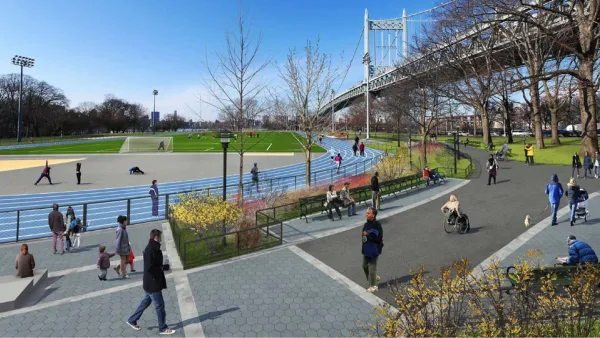
An Interview With New York Parks Commissioner Mitchell Silver, FAICP
Mitchell Silver, commissioner of the New York City Department of Parks and Recreation, former planning director of Raleigh, and former president of the APA, discusses the aspirations and realities of a long, successful career in planning.
Former APA President Allegedly Assaulted at Zoning Hearing
Don't let anyone tell you that planning isn't dangerous. Past APA President and current Raleigh Planning Director Mitchell Silver was allegedly punched by a resident opposed to rezoning that would allow the construction of a gas station.

Planetizen Federal Action Tracker
A weekly monitor of how Trump’s orders and actions are impacting planners and planning in America.

The state-sanctioned urbicide of Austin
People don’t kill cities. Freeways do.

Colorado’s Largest Data Center Could Rise Next to Homes — Without a Public Hearing
The proposed campus would consume 11 times the power of Denver International Airport; as it has across the country, opposition mounts.

Nation's most wind-powered state turns to coal as data centers increase energy demand
For the first time in decades, Iowa has increased its generation of coal power.

NYC cools commuters with city's first rain garden above a bus stop
New York City officials say the plants in the rain garden can absorb 16 gallons of rainwater during heavy storms.

Brightline West’s future may rely on $6 billion federal loan
The company has until Nov. 2 to make a $400 million equity investment into its proposed high-speed rail line.

FREE Course: Walkable City 1: Why Walkability?
After describing his path towards focusing on walkability as the essence of good planning, Jeff Speck marches through his five principal reasons for making more walkable places.
Reinventing Malls: Planning Alchemy—Turning Gray Fields Into Gold
The course focuses on the opportunities and imperatives that shape reinvention of mall sites.

Greater Baltimore Committee
Eagle County Government
Harvard University Graduate School of Design
The Architects Foundation
University of Cincinnati Online
The Pocatello Development Authority
The Urban Renewal Agency of the City of Pocatello
Journal of the American Planning Association