Return on Investment

Opinion: When New Growth Is Really a 'Giant Ponzi Scheme'
Development that depends on subsidies is not fostering true growth and instead is a financial house of cards.
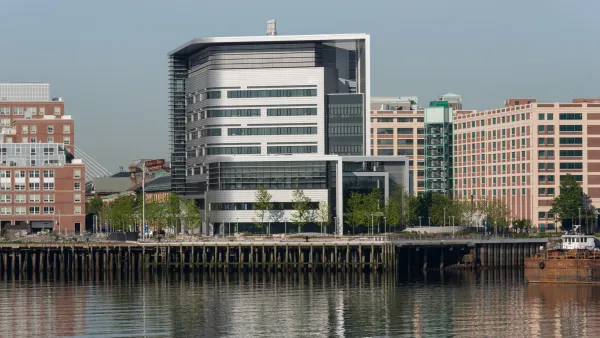
Building for Resilience Makes (Good Business) Sense
The Urban Land Institute (ULI) is showing developers how resilience can benefit the bottom line in the "Returns on Resilience" report. Sarene Marshall, director of the ULI Center for Sustainability, offers insight into the report's examples.
Key Questions Remain for New York City's Affordable Housing Plan
Although Mayor Bill de Blasio's recent announcements provided some important details about his administration's affordable housing agenda, there are a few questions still left to be answered that will determine the success of the plan.

Are Skyscrapers Profitable?
Yes and no, says Peter Bill. As a look at London's delightfully nicknamed towers - the Shard, the Walkie-Talkie, the Cheesegrater - shows, it may take years, and multiple economic cycles for skyscrapers to recoup their investment.
To Stretch Strained Municipal Budgets, Build Smart
Utilizing 17 case studies, a new report from Smart Growth America examines the costs and benefits of competing development strategies. Any way you slice it, smart growth strategies are more financially prudent than building sprawl.
Walkable Infill Proves Its Worth
A study of three different development types in Nashville shows that mixed-use infill projects deliver an exponentially greater return on investment than traditional suburban, or even New Urbanist-style, greenfield development.
Economic Development and Planning: It's a Match!
Mitchell Silver, Raleigh City Planner and President of the APA, is on a mission to get planners to realize the importance of return on investment (ROI) in their projects. Raleigh is providing the testing ground for his arguments.
Finding Returns in Lean Times
Connecting existing assets and social networks with very little additional monetary investment can generate returns in lean times, writes Hazel Borys.

FREE Course: Walkable City 1: Why Walkability?
After describing his path towards focusing on walkability as the essence of good planning, Jeff Speck marches through his five principal reasons for making more walkable places.
Reinventing Malls: Planning Alchemy—Turning Gray Fields Into Gold
The course focuses on the opportunities and imperatives that shape reinvention of mall sites.

City of Rosemead
Rutgers University, Edward J. Bloustein School of Planning and Public Policy
One Hundred Miles
University of Michigan School for Environment and Sustainability (SEAS)
Hunter College, City University of New York (CUNY)
The Architects Foundation
City of Cambridge
Montrose County
The Pocatello Development Authority









