A suburban farming model based on shared private garden plots springs up in Needham, Massachusetts. Could Kate Canney's experiment be an antidote to the challenge of finding farmland that plagues prospective farmers nationwide?


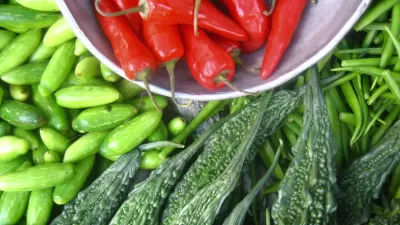
Canney, a resident of the Boston suburb of Needham, MA, noticed that most of the yard space in her neighborhood was being used to grow lawns. Interested in pursuing her dream of farming, she started talking to friends about converting some of this valuable private outdoor space to food production.
The idea caught on, and neighbors approached her with requests to convert their lawns into viable vegetable gardens. Thus The Neighborhood Farm was born.
Currently farming two thirds of an acre across six different gardens (plus a 3 acre field) within a 15-minute driving loop of one another, Canney grows a wide variety of herbs, cut flowers and vegetables without synthetic pesticides, diversifying each plot and rotating crops from year to year.
Neighbors who donate their land receive credit at The Neighborhood Farm's local farmer's market locations and fresh produce from their own backyards.
Read the full story: The Neighborhood Farm: An Urban Farming Initiative

Desperate measures: Advocates weigh draining Lake Powell to fill Colorado River
Draining the reservoir could reduce evaporation losses by a couple hundred thousand acre-feet.

Eastern Nebraska is running out of electricity
Data centers and electrification are straining eastern Nebraska’s grid, throttling economic development.

Malls are becoming the midtowns of the future
Mall and office park redevelopments are a generational opportunity to create new nodes of urbanity.

NYC breaks ground on anti-flooding infrastructure project
New York City's new system will reduce stormwater flows to local sewers by 90%.

One Kentucky town’s secret to affordable housing
The Smoketown Community Land Trust has already built seven affordable homes for community members.

Houston gains petal-shaped cooling infrastructure to make streets more ‘delightful’
The city has installed the pavilions along 15 blocks in Houston.

FREE Course: Walkable City 1: Why Walkability?
After describing his path towards focusing on walkability as the essence of good planning, Jeff Speck marches through his five principal reasons for making more walkable places.
Reinventing Malls: Planning Alchemy—Turning Gray Fields Into Gold
The course focuses on the opportunities and imperatives that shape reinvention of mall sites.

City of Rosemead
Rutgers University, Edward J. Bloustein School of Planning and Public Policy
One Hundred Miles
University of Michigan School for Environment and Sustainability (SEAS)
Hunter College, City University of New York (CUNY)
The Architects Foundation
City of Cambridge
Montrose County
The Pocatello Development Authority