John King looks at how Wright's Marin County Civic Center, which the architect described as a "three-dimensional essay on the relationship between government and governed," has stood the test of time.


Designed in 1959, near the end of Wright's life, the Civic Center is described by Victor Sidy, dean of the Frank Lloyd Wright School of Architecture in Arizona, as no less than "a true realization of his ideals about society."
Although some aspects of the building have not weathered well - its roof has leaked almost from the start - King describes it as "that rarest of buildings: a popular favorite that also holds lessons for architectural scholars."
"His creation indeed is organic," says King, "sumptuous curves poured across the
landscape beneath a long low sky-blue roof, yet futuristic enough that
the building was used as a set in the science-fiction movies 'Gattaca'
and 'THX-1138.' Above all else it is confident - embracing at once the
natural setting of the tumbling hills and the imposed potential of a
structure where citizens can check out a book, go on trial, get married
and grab a quick lunch."
Read the full story: At 50, Marin Civic Center comes of age
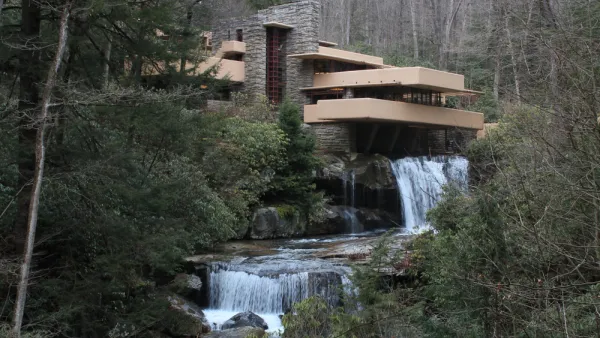
8 Frank Lloyd Wright Buildings Named World Heritage Sites
Eight buildings designed by Frank Lloyd Wright are the first works of U.S. modern architecture to be named UNESCO World heritage sites.
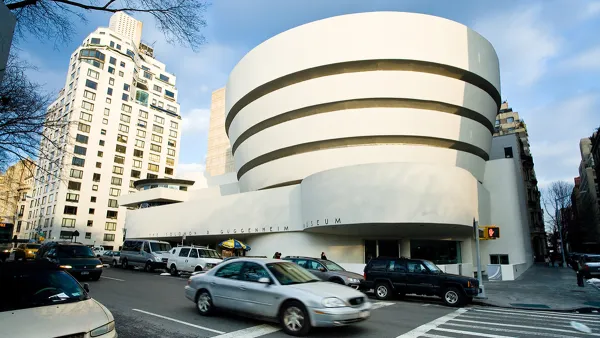
8 Frank Lloyd Wright Buildings Nominated as UNESCO World Heritage Sites
If accepted as UNESCO World Heritage sites, the eight Frank Lloyd Wright buildings would be the first examples of modern architecture in the United States included in that august company.
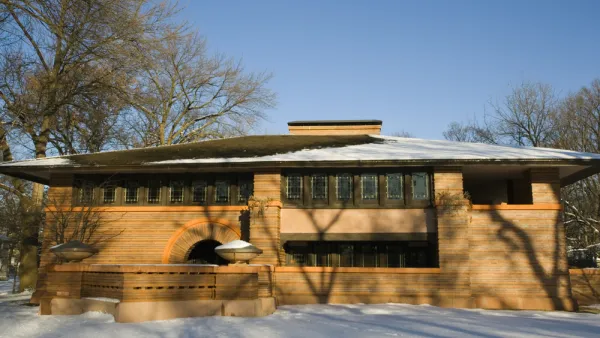
National or Regional? Finding American Identity in Architecture
In an extended discussion, Keith Eggener examines what it means for a work of architecture to be "naturally" American, and why looking at modern American styles through an intensively regional lens may be unhelpful.

Planetizen Federal Action Tracker
A weekly monitor of how Trump’s orders and actions are impacting planners and planning in America.

California plans to bury El Niño’s downpour
If the state plays its cards right, it may be able to store a billion acre-feet of El Niño’s water in aquifers.

Desperate measures: Advocates weigh draining Lake Powell to fill Colorado River
Draining the reservoir could reduce evaporation losses by a couple hundred thousand acre-feet.

Mamdani’s pied-à-terre tax survives legal challenge
A panel of judges found that the plaintiffs failed to demonstrate injury as a result of New York City's implementation of the tax.

Eastern Nebraska is running out of electricity
Data centers and electrification are straining eastern Nebraska’s grid, throttling economic development.

Seattle passes record-breaking transit services expansion
Proposition 1 will double the city’s transit tax to add 95,000 more bus trips and preserve 180,000 bus trips annually.

FREE Course: Walkable City 1: Why Walkability?
After describing his path towards focusing on walkability as the essence of good planning, Jeff Speck marches through his five principal reasons for making more walkable places.
Reinventing Malls: Planning Alchemy—Turning Gray Fields Into Gold
The course focuses on the opportunities and imperatives that shape reinvention of mall sites.

City of Rosemead
Rutgers University, Edward J. Bloustein School of Planning and Public Policy
One Hundred Miles
Hunter College, City University of New York (CUNY)
The Architects Foundation
University of Cincinnati Online
City of Cambridge
Montrose County
The Pocatello Development Authority