Daniel Michaels and Mary M. Lane recount the 16-year drama, now verging on farce, surrounding the delayed grand opening of Berlin's new airport.


Much to the chagrin of a country that prides itself on punctuality, the opening of the Berlin Brandenburg Airport, which was slated for its flying start this June, has been pushed back to next March. The much anticipated opening, in preparation for which 10,000 Berliners impersonated airline passengers in simulated scenarios to work out the kinks, has reportedly been pushed back 10 months due to problems in the terminal's fire-control systems.
Other criticisms and concerns have plagued Brandenburg's inaugural opening. "Critics call it a waste," says Berliner Frank Welskop who has written a book attacking the project's years of legal battles, delays and budget overruns. He warns that the airport "will just become a sinkhole for billions of euros."
Moreover, Berliners resistant to change are not ready to say auf Wiedersehen to historic Tegel Airport. Many East Berliner's first flights to the West were from Tegel after the fall of the Berlin Wall, note Michaels and Lane.
Thanks to Daniel Lippman
Read the full story: Berlin's New Airport Is Racking Up Delays Even Before It Opens
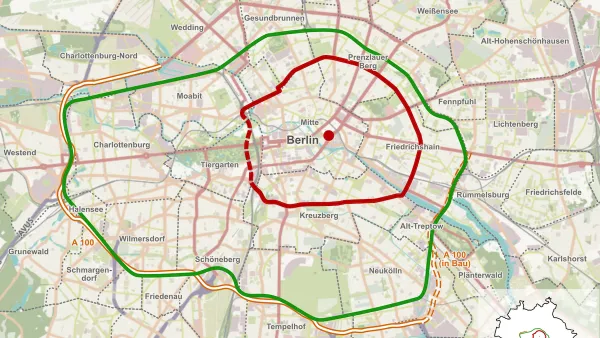
Berlin to Consider Car-Free Zone Larger Than Manhattan
The area bound by the 22-mile Ringbahn would still allow 12 uses of a private automobile per year per person, and several other exemptions.
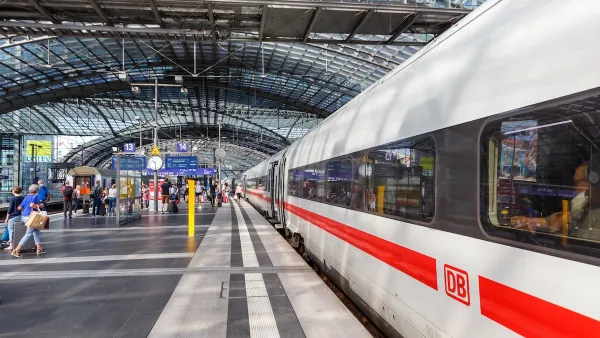
New HSR Train Conects Paris and Berlin
Officials hail the new route as a symbol of the friendship between two of Europe’s most important economic powers.
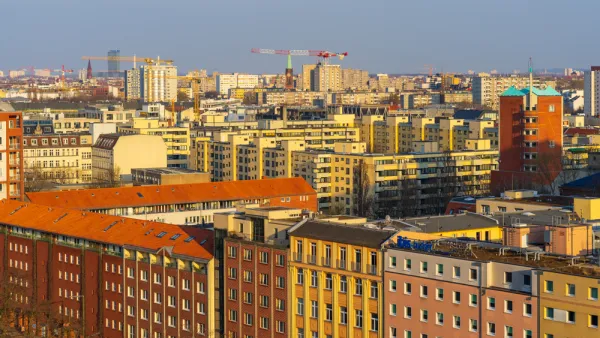
What Housing Organizers in the U.S. Can Learn from Berlin's Re-Socialization Campaign
More than half of Berlin voters approved a non-binding referendum to resocialize a quarter-million apartments. What can housing organizers in the U.S. learn?

Planetizen Federal Action Tracker
A weekly monitor of how Trump’s orders and actions are impacting planners and planning in America.

Eastern Nebraska is running out of electricity
Data centers and electrification are straining eastern Nebraska’s grid, throttling economic development.

Study reveals best places in the U.S. for cycling, walking
New research from Streetlight Data examines bicycle and pedestrian miles per capita in the 100 largest U.S. cities by population.

DSA members accuse Mamdani of 'abandoning values' over housing redevelopment
New York City's mayor plans to replace about 2,000 units of public housing with private, mixed-income housing.

All sides of BRT debate unhappy with CDOT’s most recent move
The Colorado Department of Transportation is no longer considering center-running bus lanes for Colorado Boulevard.

Massachusetts bogs generate both power, and cranberries
Putting solar panels above farmland is one way Massachusetts is advancing toward its goal of net-zero carbon emissions by 2050.

FREE Course: Walkable City 1: Why Walkability?
After describing his path towards focusing on walkability as the essence of good planning, Jeff Speck marches through his five principal reasons for making more walkable places.
Reinventing Malls: Planning Alchemy—Turning Gray Fields Into Gold
The course focuses on the opportunities and imperatives that shape reinvention of mall sites.

City of Rosemead
Rutgers University, Edward J. Bloustein School of Planning and Public Policy
One Hundred Miles
University of Michigan School for Environment and Sustainability (SEAS)
Hunter College, City University of New York (CUNY)
The Architects Foundation
City of Cambridge
The Pocatello Development Authority
The Urban Renewal Agency of the City of Pocatello