Lisa Hymas has a fascinating look at the anti-sprawl effort championed by Mitt Romney during his time as Governor of Massachusetts, which became the model for a key Obama “smart growth” initiative — the Partnership for Sustainable Communities.


Apparently, President Obama looked to Mitt Romney's time as Governor of Massachusetts for policy lessons on more than just health care. As Hymas reports, "As governor of Massachusetts, Romney actively fought sprawl and promoted density. He ran on a smart-growth platform: 'Sprawl is the most important quality-of-life issue facing Massachusetts,' he said in 2002...After winning, Romney swiftly set about remaking state government to encourage smarter land use."
The result of this effort was the creation of Massachussets' Office for Commonwealth Development, "a 'super-secretariat' or umbrella office for state agencies dealing with transportation, housing, energy, and the environment. It made sure the agencies were all pulling in the same direction toward smart-growth goals - concentrating development in town centers, constructing housing near transit stations, fixing existing roads instead of building new ones."
Hymas tracks the ways in which the Obama administration followed Romney's lead in establishing the cross-agency Partnership for Sustainable Communities to incentivize local communities to embrace smart growth; how the GOP has attacked the program and Smart Growth policies in general; and attempts to answer the question "Where's Mitt now?"
Read the full story: Romney, once an anti-sprawl crusader, created model for Obama ‘smart growth’ program
Mystery Surrounds Mitt's Urban Agenda
On the eve of the election, with scant mention of his position on issues such as transportation, smart growth, climate change, or even housing while on the campaign trail, Emily Badger tries to divine Mitt Romney's approach to urban issues.
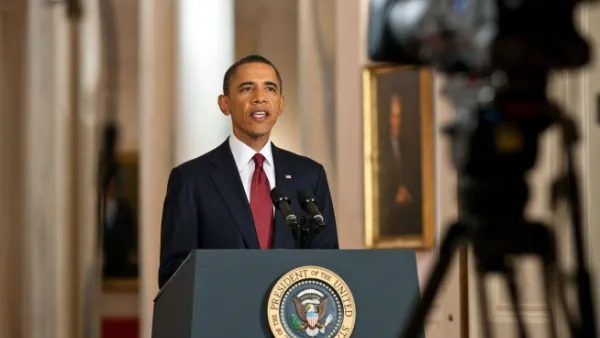
Grading Obama's Approach to Transportation
Was Obama's top transportation achievement his decision to name Ray LaHood as U.S. DOT secretary? That's the argument Tanya Snyder makes in evaluating the President's hits and misses regarding transportation policy.
Hurricane Sandy Has Something to Say About Climate Change
The silence on climate change during the presidential debates was deafening. With Hurricane Sandy disrupting the final week of the campaign, Mother Nature is having the last word.

Planetizen Federal Action Tracker
A weekly monitor of how Trump’s orders and actions are impacting planners and planning in America.

California plans to bury El Niño’s downpour
If the state plays its cards right, it may be able to store a billion acre-feet of El Niño’s water in aquifers.

Desperate measures: Advocates weigh draining Lake Powell to fill Colorado River
Draining the reservoir could reduce evaporation losses by a couple hundred thousand acre-feet.

US buildings threatened, destroyed by fires set to triple by 2060
Researchers found a high fire risk for socioeconomically vulnerable neighborhoods in the American West.

LA residents may be allowed to paint their own crosswalks
Councilwoman Katy Yaroslavsky put out a motion instructing the Los Angeles Department of Public Transportation to study the feasibility of allowing volunteers to paint crosswalks.

Dallas moves to overhaul its zoning code
The city's zoning reform will allow more multi-family and mixed-use developments.

FREE Course: Walkable City 1: Why Walkability?
After describing his path towards focusing on walkability as the essence of good planning, Jeff Speck marches through his five principal reasons for making more walkable places.
Reinventing Malls: Planning Alchemy—Turning Gray Fields Into Gold
The course focuses on the opportunities and imperatives that shape reinvention of mall sites.

City of Rosemead
Rutgers University, Edward J. Bloustein School of Planning and Public Policy
One Hundred Miles
Hunter College, City University of New York (CUNY)
The Architects Foundation
University of Cincinnati Online
City of Cambridge
Montrose County
The Pocatello Development Authority