Nearly 10 years in the works, a connector between Oakland International Airport and the BART transit system is taking shape.


"Within two years, cable-drawn, three-car trains will transport passengers from the Coliseum BART station to Oakland International Airport along an elevated track that proponents of the project say will be faster and more reliable than the current AirBART bus system.
For them, the columns signify an important victory in a long and hard-fought battle over a new transportation connection that, they say, will not only ensure continued growth at Oakland's airport but also provide much needed construction jobs for Bay Area workers.
Once completed, the almost $500 million connector will have created at least 2,500 jobs, proponents predict, and offer the Bay Area a signature extension to a growing transportation network much like the new eastern span of the Bay Bridge or the international terminal at San Francisco's airport."
But opponents still argue the project is a waste that will put taxpayers even deeper in debt.
Thanks to Nate Berg
Read the full story: BART airport connector rising but still stirring debate


The Many Ongoing Public Transportation Projects of the Bay Area
The San Francisco Chronicle offers a round-up of 11 big transit projects, by Caltrans, BART, SFMTA, and others, making progress around the bay.
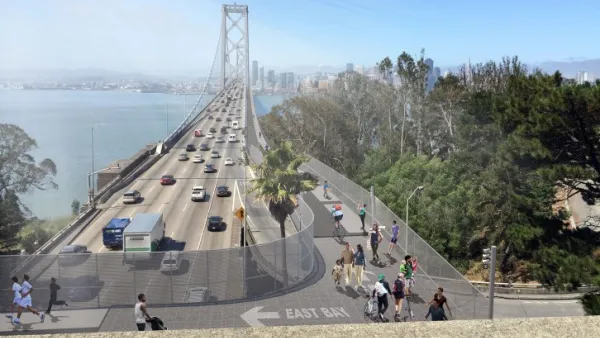
Planning Underway for New Bay Bridge Bike Path, and a Second Transbay BART Tube
In a distant and expensive future, there are two new ways to get across the San Francisco Bay without a car. One will have a much better view.
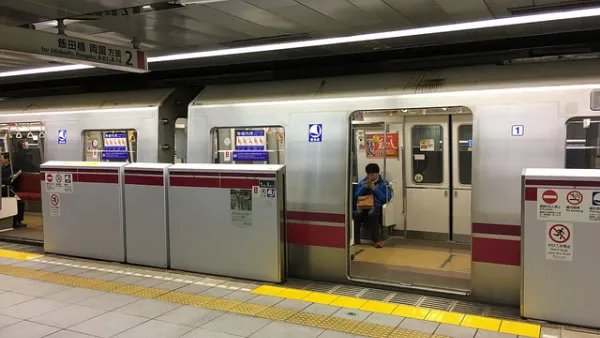
'Screen Door' Pilot to Be Installed at Oakland BART Station
The 12th Street station in Oakland, California will provide an initial test of a rail transit safety technology known as screen doors. Screen doors are rare in the United States, but not in other parts of the world.

Planetizen Federal Action Tracker
A weekly monitor of how Trump’s orders and actions are impacting planners and planning in America.

California plans to bury El Niño’s downpour
If the state plays its cards right, it may be able to store a billion acre-feet of El Niño’s water in aquifers.

Chicago breaks ground on $3 billion megadevelopment
The new neighborhood, titled Foundry Park, will one day host 3,700 residences.

California High-Speed Rail Authority CEO resigns after $600,000 scandal
Under Ian Choudri, the authority used taxpayer dollars to fund first class flights and trips to nightclubs.

Want to study the Missouri River? Soon, you may need unanimous approval from 10 states
Legislation would require 10 governors’ permission to study or build projects moving water outside the basin.

Desperate measures: Advocates weigh draining Lake Powell to fill Colorado River
Draining the reservoir could reduce evaporation losses by a couple hundred thousand acre-feet.

FREE Course: Walkable City 1: Why Walkability?
After describing his path towards focusing on walkability as the essence of good planning, Jeff Speck marches through his five principal reasons for making more walkable places.
Reinventing Malls: Planning Alchemy—Turning Gray Fields Into Gold
The course focuses on the opportunities and imperatives that shape reinvention of mall sites.

City of Rosemead
Rutgers University, Edward J. Bloustein School of Planning and Public Policy
One Hundred Miles
Hunter College, City University of New York (CUNY)
The Architects Foundation
University of Cincinnati Online
City of Cambridge
Montrose County
The Pocatello Development Authority