Suburban areas don't necessarily equate with car-dependence, according to some New Urbanist plans for far-out areas. But convincing residents to opt for transit can be a challenge.


This article from Scientific American looks at the concept of reducing car use in the suburbs, and cites the example of King Farm, Maryland a New Urbanist suburb that didn't want transit.
"Instead of embracing that transportation vision, however, the residents of King Farm and the Rockville City Council recently rejected the proposed transit plan-specifically, any light-rail line that would travel down the swath of green explicitly designed to host such a system.
Transit-ready development may mean nothing if local residents are not ready for public transit. And King Farm residents seem prepared to fight the State of Maryland, which bears ultimate responsibility for the decision and still wants to route any transit system through the community. The battle highlights one of the challenges facing so-called new urbanism as it attempts to steer American life away from the car, which has dominated city planning since at least the 1950s.
Read the full story: Can Suburbs Be Designed to Do Away with the Car?

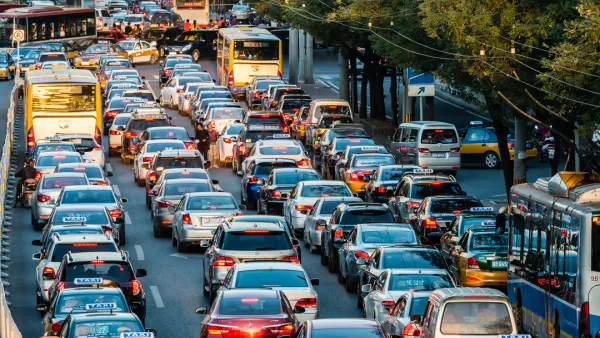
Study Shows Link Between Car Ownership and Decrease in Physical Activity
A study of residents in Beijing, China who became car owners indicates that they used alternative transportation modes less after buying cars.
Car Manufacturers Worried After Trump Administration Gave More Than Expected
The auto industry lobby is meeting with Trump Administration officials to convince them to ease off the throttle.

Trump’s Backlash to EVs Is Making All Cars More Expensive — Including Ones that use Gas
Uncertainty about vehicle standards and anti-renewable energy policies are raising the cost of both buying and maintaining a car.

Planetizen Federal Action Tracker
A weekly monitor of how Trump’s orders and actions are impacting planners and planning in America.

California plans to bury El Niño’s downpour
If the state plays its cards right, it may be able to store a billion acre-feet of El Niño’s water in aquifers.

Chicago breaks ground on $3 billion megadevelopment
The new neighborhood, titled Foundry Park, will one day host 3,700 residences.

Satanic Place Names
From streams and lakes to valleys and canyons, I mapped more than 1,000 places named after the Devil.

California High-Speed Rail Authority CEO resigns after $600,000 scandal
Under Ian Choudri, the authority used taxpayer dollars to fund first class flights and trips to nightclubs.

Want to study the Missouri River? Soon, you may need unanimous approval from 10 states
Legislation would require 10 governors’ permission to study or build projects moving water outside the basin.

FREE Course: Walkable City 1: Why Walkability?
After describing his path towards focusing on walkability as the essence of good planning, Jeff Speck marches through his five principal reasons for making more walkable places.
Reinventing Malls: Planning Alchemy—Turning Gray Fields Into Gold
The course focuses on the opportunities and imperatives that shape reinvention of mall sites.

City of Rosemead
Rutgers University, Edward J. Bloustein School of Planning and Public Policy
One Hundred Miles
Hunter College, City University of New York (CUNY)
The Architects Foundation
University of Cincinnati Online
City of Cambridge
Montrose County
The Pocatello Development Authority