The auto industry lobby is meeting with Trump Administration officials to convince them to ease off the throttle.


The auto industry lobby backed candidate Trump in the hopes that he would allow for lax fuel efficiency standard. Now it fears Trump will make those standards so lax it will hurt their profit margins.
California has a higher environmental standard regardless of the federal guidelines, so some in the industry now fear a Trump rollback will split the country into two, costly to serve, markets. "The auto industry, embracing Mr. Trump’s promise of a more industry-friendly administration, has lobbied aggressively for a relaxation of the strict Obama-era rules," Hiroko Tabuchi and Neal E. Boudette report in The New York Times.
For their part, the administration insists the move to allow lower fuel efficiency makes sense and should provide automakers with an opportunity. This leaves the industry and its lobby in an awkward position. "On one hand, they are eager to stay in the good graces of a president who not only is intent on moving forward his deregulatory agenda, but who is also capable, if so inclined, of hurling insults at automakers on Twitter or pushing for damaging tariffs. At the same time, automakers are eager to find a way to work with California, which is intent on sticking with the Obama-era rules and has threatened to sue if the federal government gets in the way," Tabuchis and Boudette explain.
Industry observers point out that if even the automakers are not interested in pushing fuel efficiency standards so low, the intent must be entirely political.
FULL STORY: Automakers Sought Looser Rules. Now They Hope to Stop Trump From Going Too Far


Trump’s Backlash to EVs Is Making All Cars More Expensive — Including Ones that use Gas
Uncertainty about vehicle standards and anti-renewable energy policies are raising the cost of both buying and maintaining a car.
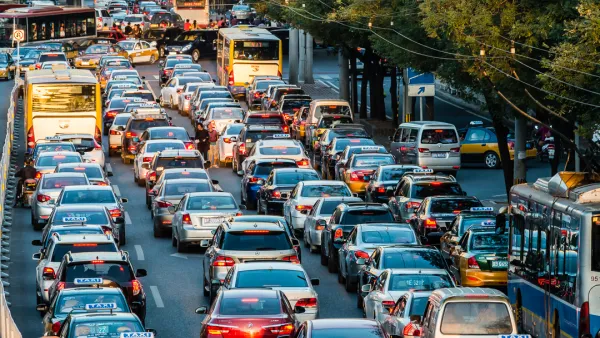
Study Shows Link Between Car Ownership and Decrease in Physical Activity
A study of residents in Beijing, China who became car owners indicates that they used alternative transportation modes less after buying cars.
The Trouble with Designing for Transit Preference
Suburban areas don't necessarily equate with car-dependence, according to some New Urbanist plans for far-out areas. But convincing residents to opt for transit can be a challenge.

The state-sanctioned urbicide of Austin
People don’t kill cities. Freeways do.

US to reduce Colorado River water deliveries to Mexico
A new Colorado Treaty amendment reduces Mexico’s Colorado River water allocation by 250,000 acre feet.

New Jersey’s second-largest city bans standalone data centers
Jersey City will continue to allow co-location facilities, such as those meant for research institutions that store their own data.

Amtrak not solely to blame for New Jersey commuter rail's unreliability, report finds
A new study from the Garden State Initiative found that NJ Transit’s budget grew 20% across a 4 year period, but reliability declined significantly over the same period.

EPA erases limits on planet-warming pollution from power plants
Under Monday’s plan, power plants would still have some limits on how much mercury, arsenic and other contaminants they can emit.

Phoenix announces new on-demand transit service, more frequent RAPID buses
Both new services will launch in October, and are part of Phoenix's Project Effective Access Solutions for Easing Congestion.

FREE Course: Walkable City 1: Why Walkability?
After describing his path towards focusing on walkability as the essence of good planning, Jeff Speck marches through his five principal reasons for making more walkable places.
Reinventing Malls: Planning Alchemy—Turning Gray Fields Into Gold
The course focuses on the opportunities and imperatives that shape reinvention of mall sites.

Eagle County Government
Harvard University Graduate School of Design
Nashville Planning Department
The Architects Foundation
University of Cincinnati Online
The Pocatello Development Authority
The Urban Renewal Agency of the City of Pocatello
Journal of the American Planning Association