Detroit has become our most notorious story of urban collapse. But reporter Matthew Power suggests that we consider the city's official motto: "It shall rise from the ashes."


Power looks at the efforts underway to fix the Motor City, including a new light rail and "right-sizing":
"A new land bank could make use of some of the 42,300 city-owned parcels of land, spurring job development, green space, and urban agriculture. A city without a single national grocery chain has more than 600 community gardens, so why not turn a food desert into an example of food self-sufficiency? Rather than being a cautionary tale of hubris and decay, Detroit could shed the carapace of its history and be a model of sustainability and progress for other postindustrial cities."
Thanks to Scott Dodd
Read the full story: Motown Revival?

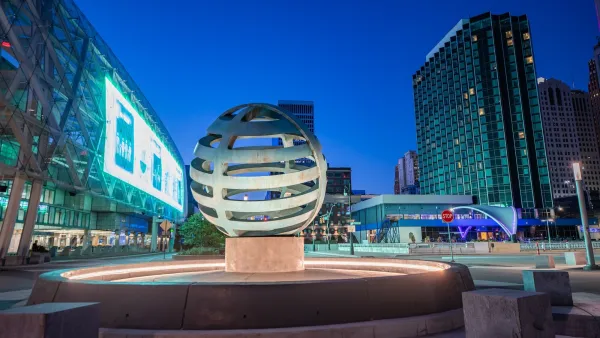
APA conference draws 4,000 urban planners to Detroit this weekend
The annual conference brings together planners for a weekend of panels, discussions and tours.

The Natalist Case For Sprawl (And Why It Fails)
Some commentators defend anti-urban government policies such as exclusionary zoning on the basis that homeowning suburbanites have high birth rates. But this doesn't seem to be true in recent decades.
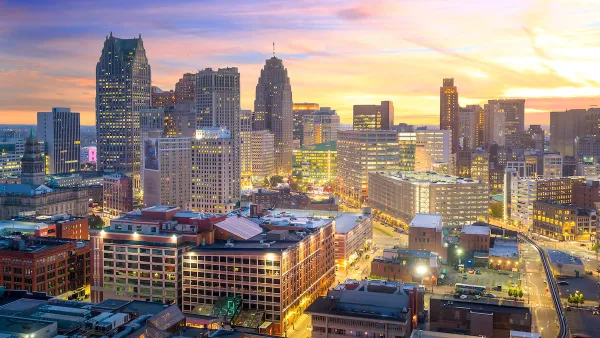
Detroit and Michigan on the Upswing
It's been 66 years since the Motor City last grew its population. Census data released last month revealed an increase of nearly 2,000 people last year, nearly half the state's population growth.

Planetizen Federal Action Tracker
A weekly monitor of how Trump’s orders and actions are impacting planners and planning in America.

California plans to bury El Niño’s downpour
If the state plays its cards right, it may be able to store a billion acre-feet of El Niño’s water in aquifers.

Desperate measures: Advocates weigh draining Lake Powell to fill Colorado River
Draining the reservoir could reduce evaporation losses by a couple hundred thousand acre-feet.

California city breaks ground on transit connector
The project includes three mobility hubs and a pedestrian bridge.

After public outcry, Massachusetts city releases housing development tracker
Cambridge’s tracker currently shows 250 housing projects in various stages of development.

40 years after approval, Chicago breaks ground on new park
The park honors Jean Baptiste Point du Sable, the city’s first permanent non-native settler.

FREE Course: Walkable City 1: Why Walkability?
After describing his path towards focusing on walkability as the essence of good planning, Jeff Speck marches through his five principal reasons for making more walkable places.
Reinventing Malls: Planning Alchemy—Turning Gray Fields Into Gold
The course focuses on the opportunities and imperatives that shape reinvention of mall sites.

City of Rosemead
Rutgers University, Edward J. Bloustein School of Planning and Public Policy
One Hundred Miles
Hunter College, City University of New York (CUNY)
The Architects Foundation
University of Cincinnati Online
City of Cambridge
Montrose County
The Pocatello Development Authority