In Providence, Rhode Island, a team of young developers are breathing new life into an old factory complex. But it's not your typical condo conversion.


The team is re-working the facility into a newer industrial center, where people can learn and hone craft trades.
"Instead of a business plan, the founders-Clay Rockefeller, a 32-year-old Brown graduate and the great-great-grandson of John D. Rockefeller, and Nick Bauta, a 34-year-old RISD graduate and the grandson of the Canadian food magnate W. Garfield Weston-started in 2001 with some big ideas and enough money to acquire the $1.4 million, three-acre Providence Steel & Iron complex at 27 Sims Avenue. 'We wanted to approach the question of what to do with a historically industrial property in light of the changes to the area,' Rockefeller says. 'I was particularly interested in what the next successful model for industry would look like, and if it could be sustainable in a scaled-down way that focused on local markets.'"
Read the full story: Community Activists: Rising from the Ashes
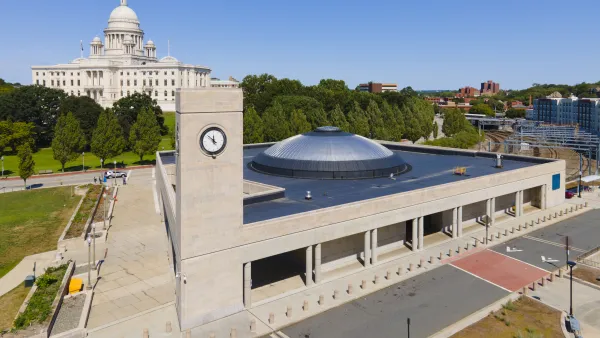
Providence train station to gain new bus hub
The new hub will replace the one currently located at Kennedy Plaza.
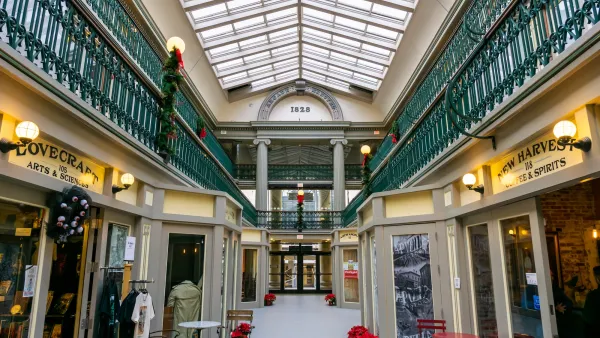
You Can Live Inside America’s Oldest Indoor Shopping Mall
The Arcade in Providence, Rhode Island, first built in 1828, was redeveloped into 48 micro-housing units.
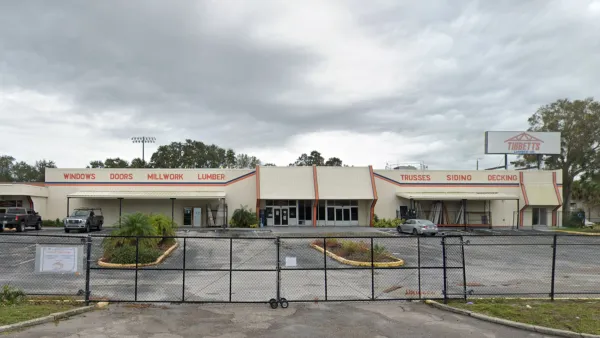
St. Pete Breaks Ground on First Industrial Zone Housing Project
A 2020 law allows cities to permit residential developments on formerly industrial land.

Planetizen Federal Action Tracker
A weekly monitor of how Trump’s orders and actions are impacting planners and planning in America.

California plans to bury El Niño’s downpour
If the state plays its cards right, it may be able to store a billion acre-feet of El Niño’s water in aquifers.

Desperate measures: Advocates weigh draining Lake Powell to fill Colorado River
Draining the reservoir could reduce evaporation losses by a couple hundred thousand acre-feet.

Mamdani’s pied-à-terre tax survives legal challenge
A panel of judges found that the plaintiffs failed to demonstrate injury as a result of New York City's implementation of the tax.

Eastern Nebraska is running out of electricity
Data centers and electrification are straining eastern Nebraska’s grid, throttling economic development.

Seattle passes record-breaking transit services expansion
Proposition 1 will double the city’s transit tax to add 95,000 more bus trips and preserve 180,000 bus trips annually.

FREE Course: Walkable City 1: Why Walkability?
After describing his path towards focusing on walkability as the essence of good planning, Jeff Speck marches through his five principal reasons for making more walkable places.
Reinventing Malls: Planning Alchemy—Turning Gray Fields Into Gold
The course focuses on the opportunities and imperatives that shape reinvention of mall sites.

City of Rosemead
Rutgers University, Edward J. Bloustein School of Planning and Public Policy
One Hundred Miles
University of Michigan School for Environment and Sustainability (SEAS)
Hunter College, City University of New York (CUNY)
The Architects Foundation
City of Cambridge
Montrose County
The Pocatello Development Authority