Cary Lowe, Los Angeles-based attorney and advocate for energy efficiency, makes the case for the economic benefits of energy efficiency retrofits to the state of California.


The op-ed builds on a recent study produced by the author entitled, "Saving the Environment; Saving the Economy":
"With the right focus, we can simultaneously save both the environment and the economy. The answer lies in our older residential and commercial buildings. California currently has approximately 13.4 million homes and about a half a million commercial buildings. Most were not subject to any energy or water efficiency requirements when constructed."
"Ten direct jobs are created for every $1 million invested in energy efficiency upgrades. An aggressive program aimed at retrofitting the 9.2 million less efficient residential units over the next ten years could generate a staggering 920,000 construction jobs. Investing another $1,650 apiece for water efficiency improvements to 7.5 million homes would generate another 124,000 construction jobs. That does not even include upgrading the commercial building stock."
Thanks to James Brasuell
Read the full story: Cary Lowe Opines on How To Save the Economy; Save Energy
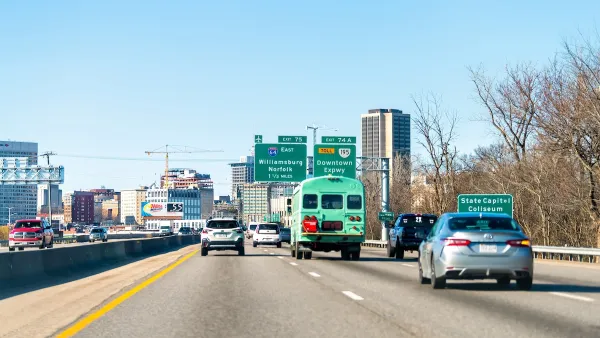
'This is going to be painful:’ Virginia stares down $1.7 billion funding gap for highway maintenance
The state may address the deficit by shifting $290 million from its construction budget to maintenance projects.

Raised interest rates may kill financially vulnerable construction projects
The chief economist at ConstructConnect warns that if construction project owners are negatively impacted by the raised rates, it could result in delayed payments to contractors.

DC energy efficiency rule requires buildings to upgrade their infrastructure or face millions in fines
Building owners and condo co-op members say the upgrades are often prohibitively expensive.

Planetizen Federal Action Tracker
A weekly monitor of how Trump’s orders and actions are impacting planners and planning in America.

California plans to bury El Niño’s downpour
If the state plays its cards right, it may be able to store a billion acre-feet of El Niño’s water in aquifers.

Desperate measures: Advocates weigh draining Lake Powell to fill Colorado River
Draining the reservoir could reduce evaporation losses by a couple hundred thousand acre-feet.

US buildings threatened, destroyed by fires set to triple by 2060
Researchers found a high fire risk for socioeconomically vulnerable neighborhoods in the American West.

LA residents may be allowed to paint their own crosswalks
Councilwoman Katy Yaroslavsky put out a motion instructing the Los Angeles Department of Public Transportation to study the feasibility of allowing volunteers to paint crosswalks.

Dallas moves to overhaul its zoning code
The city's zoning reform will allow more multi-family and mixed-use developments.

FREE Course: Walkable City 1: Why Walkability?
After describing his path towards focusing on walkability as the essence of good planning, Jeff Speck marches through his five principal reasons for making more walkable places.
Reinventing Malls: Planning Alchemy—Turning Gray Fields Into Gold
The course focuses on the opportunities and imperatives that shape reinvention of mall sites.

City of Rosemead
Rutgers University, Edward J. Bloustein School of Planning and Public Policy
One Hundred Miles
Hunter College, City University of New York (CUNY)
The Architects Foundation
University of Cincinnati Online
City of Cambridge
Montrose County
The Pocatello Development Authority