Dallas is hoping to break the ring of concrete created by the surrounding Central Expressway and Interstates 30 and 35.


"There's an evolution from the '80s to the '90s to the (2000s) for recognizing the need to create connectivity with surrounding neighborhoods," said Lill, a former city council member. " We have people living in downtown and close to downtown who want a porous border. They want to go back and forth between these neighborhoods."
Where the freeways run below street level, there are straightforward ways to bridge the divide they create. On the city's north side, for example, a $110 million deck park is being built over a sunken portion of Woodall Rodgers.
"The city planners and city visionaries prevailed to suppress the highway, which was great luck for us now because we can build the deck park and create a tunnel," Lill said.
The park will link the city's densest neighborhood, Uptown, with the Arts District. It is expected to open in 2012 with funding provided government agencies and private donors.
Read the full story: Dallas Seeks To Bridge The Concrete Ring That Surrounds Downtown
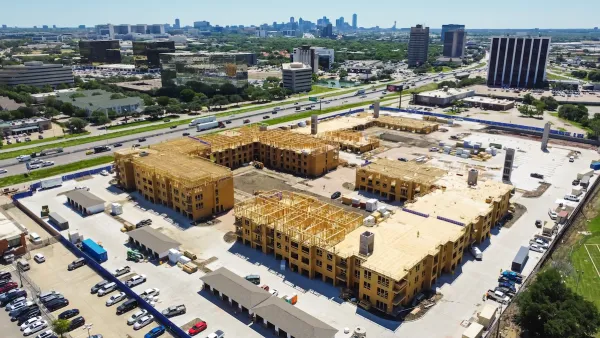
Dallas releases zoning code overhaul to officials
The drafted overhaul is over 400 pages long.
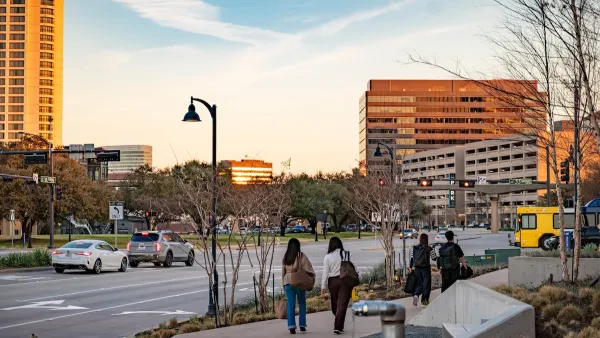
Dallas moves to overhaul its zoning code
The city's zoning reform will allow more multi-family and mixed-use developments.

Air taxis to connect Texas airports to business hubs
Archer Aviation says its taxis will turn 90 minute drives into 20 minute flights.

Planetizen Federal Action Tracker
A weekly monitor of how Trump’s orders and actions are impacting planners and planning in America.

Eastern Nebraska is running out of electricity
Data centers and electrification are straining eastern Nebraska’s grid, throttling economic development.

Study reveals best places in the U.S. for cycling, walking
New research from Streetlight Data examines bicycle and pedestrian miles per capita in the 100 largest U.S. cities by population.

Federal government nominates new FTA administrator
Mark Aesch is currently the founder and CEO of a transportation management consulting firm.

Developers reveal $10 billion stadium plan as ‘Hail Mary’ to keep Bears in Chicago
The plan would also boast a public park, high- and mid-rise buildings and a youth sports complex.

As Texas embraces carbon storage, a Black community questions the risks
Texas now issues permits for companies to store carbon dioxide underground. East Texas residents fear safety risks, and skeptics doubt the climate benefits.

FREE Course: Walkable City 1: Why Walkability?
After describing his path towards focusing on walkability as the essence of good planning, Jeff Speck marches through his five principal reasons for making more walkable places.
Reinventing Malls: Planning Alchemy—Turning Gray Fields Into Gold
The course focuses on the opportunities and imperatives that shape reinvention of mall sites.

City of Charlotte
City of Rosemead
Rutgers University, Edward J. Bloustein School of Planning and Public Policy
University of Michigan School for Environment and Sustainability (SEAS)
Hunter College, City University of New York (CUNY)
The Architects Foundation
City of Cambridge
The Pocatello Development Authority
The Urban Renewal Agency of the City of Pocatello