USA Today does some interesting analysis of the 18.4 cent federal gas tax and comes to some startling conclusions about how historically low it is when considered with vehicle miles driven and per capita income.


Despite support from notable users groups including the American Trucking Associations and AAA for improving road conditions, political support for raising the gas tax appears to also be at an all-time low.
Drivers pay "the lowest gasoline taxes since the early days of the automobile. They pay less than ever at the pump for upkeep of the nation's roads - just $19 in gas taxes for every 1,000 miles driven, a USA TODAY analysis finds. That's a new low in inflation-adjusted dollars, half what drivers paid in 1975."
"Another measure of the trend: Americans spent just 46 cents on gas taxes for every $100 of income in the first quarter of 2010. That's the lowest rate since the government began keeping track in 1929. By comparison, Americans spent $1.18 in 1970 on gas taxes out of every $100 earned."
Accompanying the article is a graph of a downward sloping line showing combined federal, state, and local gas taxes paid per 1000 miles driven.
From Matthew Yglesias: The Decline of the Gas Tax: The USA Today findings "largely reflect growing fuel efficiency, which is a good thing, but also indicates that we ought to raise gasoline taxes".
Thanks to Streetsblog
Read the full story: Gas taxes give us a break at the pump

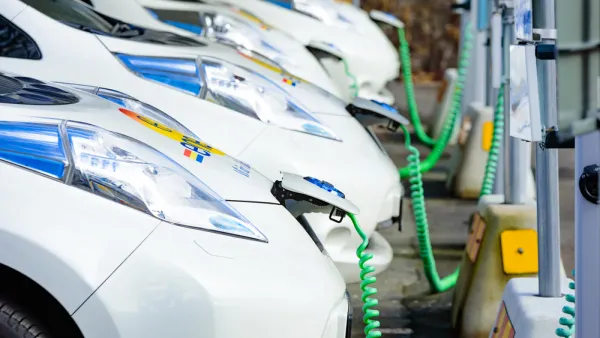
Oregon Supreme Court Rejects Challenge by AAA to Stop Electric Vehicle Rebates
A controversial new sales tax on motor vehicles in a state with no sales taxes survived a court challenge. As a result, Oregon consumers will have another reason to consider purchasing or leasing an electric vehicle: receiving up to a $5,000 rebate.
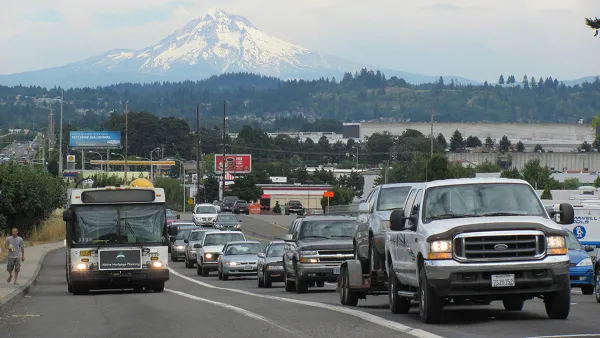
Oregon's New Motor Vehicle Sales Tax Litigated
The half-cent sales tax will fund new rebate programs for zero and near zero-emissions vehicles and multimodal transportation. Opponents claim the privilege tax, as it is called, violates the state constitution because revenues aren't used for roads.
Auto Repairs From Potholes Got You Down? You Are Not Alone
A new report from the AAA indicates that American motorists encounter damage from potholes three times a year, with each incident costing an average $300 to repair. Middle and working class drivers feel the pinch disproportionately.

Planetizen Federal Action Tracker
A weekly monitor of how Trump’s orders and actions are impacting planners and planning in America.

Amtrak, CN end decades-long dispute with eight-year agreement
The new operating agreement establishes an updated framework for the companies to work together, including processes to resolve disputes.

Judges permit Denver to divert 77,000 acre feet from the Colorado River for reservoir expansion
Overuse and climate change have caused the Colorado River’s water levels to plummet.

Boston has spent millions making the Green Line more accessible — and there’s no end in sight
While the city has invested millions into expanding and adding platforms to the Green Line to make it more accessible, new train cars set to arrive next year will be too tall for disabled passengers to board without raising the current platforms.

Idaho may see an 18% drop in federal surface transit funding — the largest estimated cut in the US
Transit systems in rural communities are much more reliant on federal funding to provide their services.

How ‘post-disaster gentrification’ alters neighborhoods after natural calamities
After hurricanes, fires or other calamities, the original residents of a community are often replaced by younger, wealthier residents.

FREE Course: Walkable City 1: Why Walkability?
After describing his path towards focusing on walkability as the essence of good planning, Jeff Speck marches through his five principal reasons for making more walkable places.
Reinventing Malls: Planning Alchemy—Turning Gray Fields Into Gold
The course focuses on the opportunities and imperatives that shape reinvention of mall sites.

City of Wisconsin Rapids
Harvard University Graduate School of Design
KFH Group Inc.
The Architects Foundation
University of Cincinnati Online
The Pocatello Development Authority
The Urban Renewal Agency of the City of Pocatello