Grist's Jonathan Hiskes spoke with smart growth leaders to devise strategies that municipalities, as opposed to U.S. government, can take to lessen oil dependency - that are financially sustainable, not overly dependent on technology, and ready to go


The ten strategies are based on land use, transportation, and smarter planning - but they do face political challenges. Lowering parking minimums and changing to form based codes may be resisted and may take time to be adopted as well as implemented. Notably missing are green building standards.
"I spoke with leaders of the Smart Growth movement, along with advocates for economic justice, to learn about solutions that don't require new technology and, in many cases, pay for themselves."
The first three recommendatings from Hiskes are:
1. Complete streets.
2. Build near transit
3. Let the market lead by reducing restrictions on compact, urban developments.
The remaining 7 strategies are in the original article.
Thanks to Weekly Grist
Read the full story: 10 ways cities and towns can kick the offshore-oil habit


All We Want for the Holidays is…
Here are a dozen timely gift ideas for creating better communities.
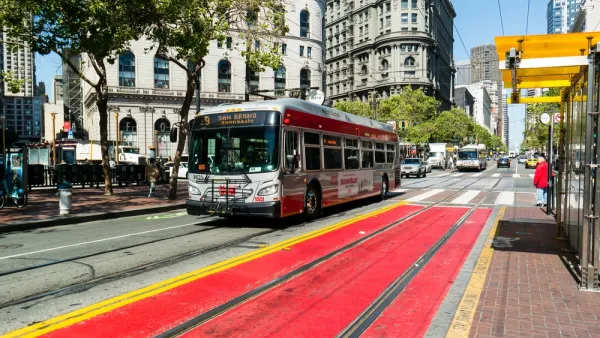
People Over Cars: The Future of San Francisco
The San Bruno Avenue Multimodal Improvement Project moved forward in San Francisco despite local resistance. The planning and political calculus behind the project is a sign of more to come in the City by the Bay.

Opinion: Housing Versus Trees Is a False Choice; Swap Pavement for Trees Instead
Seattle’s goal to cover 30 percent of the city with tree canopy by 2037 doesn’t need to be sacrificed in favor of density. There’s a better way.

Planetizen Federal Action Tracker
A weekly monitor of how Trump’s orders and actions are impacting planners and planning in America.

Northwest rail fans eager for Sept. 30 debut of Amtrak’s Airo fleet
Get ready for that new train smell and more seats. But they won’t go faster or run more frequently on the Cascades route in Washington and Oregon.

Trump is considering data centers on 6 states' public land — some state officials say they had no idea
If the administration approves the proposed projects, data center and data center-related developments will cover 17,600 acres of public land.

After decades of planning, Sacramento gains new light rail station
Trains will arrive every 15 minutes during peak hours and every 30 minutes during non-peak hours.

Massive tunnel-boring machine breaks ground on Gateway Project
The Trump administration revoked funding for the project in October 2025, and then restored it earlier this year.

Airo trainsets begin service on Amtrak Cascades route
The trains feature panoramic windows, complementary wifi and over 300 seats per train set.

FREE Course: Walkable City 1: Why Walkability?
After describing his path towards focusing on walkability as the essence of good planning, Jeff Speck marches through his five principal reasons for making more walkable places.
Reinventing Malls: Planning Alchemy—Turning Gray Fields Into Gold
The course focuses on the opportunities and imperatives that shape reinvention of mall sites.

City of Thousand Oaks
City of Wisconsin Rapids
Harvard University Graduate School of Design
The Architects Foundation
University of Cincinnati Online
Northern Illinois Transit Authority (NITA)
The Pocatello Development Authority
The Urban Renewal Agency of the City of Pocatello