Wired profiles Charles Komanoff, who's hoping to use his immense spreadsheet of New York City traffic data to clear the city's congestion.


Komanoff's been trying to measure how traffic affects the city and its people, from time lost to money spent. He also has an eye on how understanding the patterns of transportation in the city can help improve its flows.
"Komanoff will use this interview to inform his magnum opus, the Balanced Transportation Analyzer, an enormous Excel spreadsheet that he's been building for the past three years. Over the course of about 50 worksheets, the BTA breaks down every aspect of New York City transportation-subway revenues, traffic jams, noise pollution-in an attempt to discover which mix of tolls and surcharges would create the greatest benefit for the largest number of people.
Komanoff's spreadsheet, which he has posted online, calculates how new fees and changes to existing tolls affect traffic at different times of day. It calculates which costs are borne by city dwellers and which by suburbanites. It calculates how long it takes passengers to dig for change and board buses. And it allows any user to adjust dozens of different variables-from taxi surcharges to truck tolls-and measure their impact. The result is a kind of statistical SimCity, an opportunity to play God (or at least Robert Moses) and devise the perfect traffic policy."
Read the full story: The Man Who Could Unsnarl Manhattan Traffic

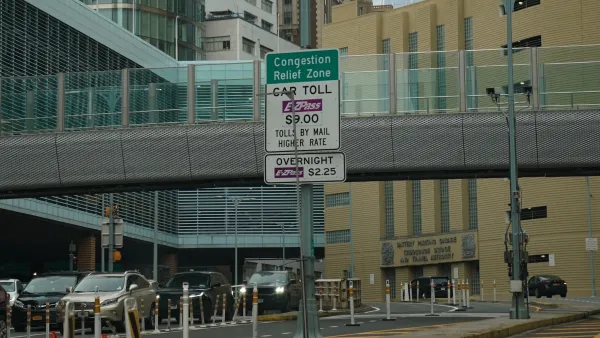
Judge Rules to Keep NYC Congestion Pricing, Ending Trump's Legal Challenge
The decision likely deals a fatal blow to efforts to end the program, but the Trump administration says it will explore other avenues for reversing the congestion pricing scheme.

NYC Congestion Pricing: Still Working
10 million fewer vehicles entered the congestion pricing zone in the first six months of the program than last year, while pedestrian fatalities are at ‘historic lows.’
Judge Extends NYC Congestion Pricing Through at Least June 9
A federal judge halted the Trump administration’s effort to kill the program, which remains in limbo as a lawsuit filed by the MTA moves forward.

Planetizen Federal Action Tracker
A weekly monitor of how Trump’s orders and actions are impacting planners and planning in America.

Northwest rail fans eager for Sept. 30 debut of Amtrak’s Airo fleet
Get ready for that new train smell and more seats. But they won’t go faster or run more frequently on the Cascades route in Washington and Oregon.

Trump is considering data centers on 6 states' public land — some state officials say they had no idea
If the administration approves the proposed projects, data center and data center-related developments will cover 17,600 acres of public land.

After decades of planning, Sacramento gains new light rail station
Trains will arrive every 15 minutes during peak hours and every 30 minutes during non-peak hours.

Massive tunnel-boring machine breaks ground on Gateway Project
The Trump administration revoked funding for the project in October 2025, and then restored it earlier this year.

Airo trainsets begin service on Amtrak Cascades route
The trains feature panoramic windows, complementary wifi and over 300 seats per train set.

FREE Course: Walkable City 1: Why Walkability?
After describing his path towards focusing on walkability as the essence of good planning, Jeff Speck marches through his five principal reasons for making more walkable places.
Reinventing Malls: Planning Alchemy—Turning Gray Fields Into Gold
The course focuses on the opportunities and imperatives that shape reinvention of mall sites.

City of Thousand Oaks
City of Wisconsin Rapids
Harvard University Graduate School of Design
The Architects Foundation
University of Cincinnati Online
Northern Illinois Transit Authority (NITA)
The Pocatello Development Authority
The Urban Renewal Agency of the City of Pocatello