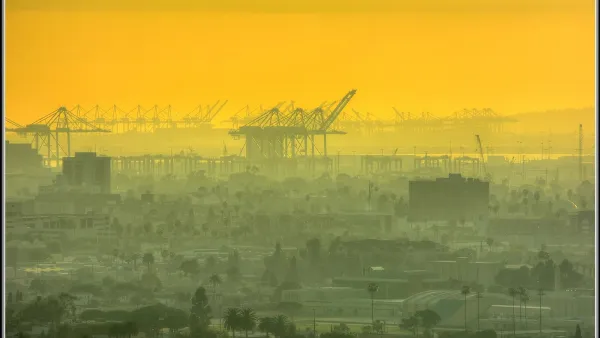
The single largest source of air pollution in Southern California are the Ports of LA and Long Beach. Environmentalists, environmental justice advocates, and Teamsters are working together to replace offending diesel drayage trucks.


Emissions from diesel trucks are one of the main reasons why the ports are such pollution-generators. Many of the trucks are old and driven by independent contractors, making their replacement both necessary and difficult for the drivers.
"Working with environmentalists, the union helped persuade the Port of Los Angeles to adopt a far-reaching plan that bars old trucks from hauling cargo from the port and puts the burden of buying new vehicles on the trucking companies, not the drivers.
Environmental groups are happy to have the Teamsters' political muscle behind efforts to clean up the ports, while the union likes having environmentalists backing its goal: requiring port trucking companies to employ their drivers directly, rather than as independent contractors because employees, unlike contractors, can join unions."
Thanks to Mathews Hollinshead
Read the full story: Clearing the Air at American Ports

Teamsters And Enviros Unite
The Los Angeles and Long Beach Ports’ new Clean Trucks program is the object of a legal battle pitting Teamsters, environmental and public health groups, the NAACP, and community groups demanding clean air against trucking companies and shippers.
Port Logjam Contributing to Dismal L.A. Air Quality
Emissions from container ships idling outside Southern California's ports are adding to pollution that has blanketed the region in a noxious layer of smog.

Bipartisan Support for Federal Diesel Emissions Reduction Bill
Established in 2005 to reduce toxic diesel emissions, the Diesel Emissions Reductions Act expired in 2016. A bipartisan effort appears to be in place to see it reauthorized this year.

Planetizen Federal Action Tracker
A weekly monitor of how Trump’s orders and actions are impacting planners and planning in America.

California plans to bury El Niño’s downpour
If the state plays its cards right, it may be able to store a billion acre-feet of El Niño’s water in aquifers.

Chicago breaks ground on $3 billion megadevelopment
The new neighborhood, titled Foundry Park, will one day host 3,700 residences.

California High-Speed Rail Authority CEO resigns after $600,000 scandal
Under Ian Choudri, the authority used taxpayer dollars to fund first class flights and trips to nightclubs.

Want to study the Missouri River? Soon, you may need unanimous approval from 10 states
Legislation would require 10 governors’ permission to study or build projects moving water outside the basin.

Desperate measures: Advocates weigh draining Lake Powell to fill Colorado River
Draining the reservoir could reduce evaporation losses by a couple hundred thousand acre-feet.

FREE Course: Walkable City 1: Why Walkability?
After describing his path towards focusing on walkability as the essence of good planning, Jeff Speck marches through his five principal reasons for making more walkable places.
Reinventing Malls: Planning Alchemy—Turning Gray Fields Into Gold
The course focuses on the opportunities and imperatives that shape reinvention of mall sites.

City of Rosemead
Rutgers University, Edward J. Bloustein School of Planning and Public Policy
One Hundred Miles
Hunter College, City University of New York (CUNY)
The Architects Foundation
University of Cincinnati Online
City of Cambridge
Montrose County
The Pocatello Development Authority