The Daily Beast has released a list of the 75 worst commutes in America. Top of the list: L.A.'s Hollywood Freeway.


By comparing rush hour congestion and free-flowing traffic difference, the 75 worst metro areas were identified.
"It was a two-step process, done with data from traffic-tracking firm INRIX, which culls information nationwide from more than 1.5 million GPS units, mostly in freight trucks.
Our first step was ranking the metropolitan areas with the worst rush-hour congestion. The order is based on the peak hour Travel Time Index (TTI) for the metropolitan area each highway is in. TTI is a measure of how much longer it takes to complete a road journey during peak congestion hours compared to free-flow hours. (Peak hours are defined as 6 a.m. to 10a.m., and 3 p.m. to 7 p.m.) Speeds during non-peak hours are used by INRIX to establish this free-flow baseline.
After determining the 75 worst metro areas, we then found the worst highway in each, defined as the most hours of bottleneck congestion, as reported by INRIX. The rankings then provide a still deeper look-at the most congested bottleneck segment for the worst highway in each area."
Read the full story: America's 75 Worst Commutes
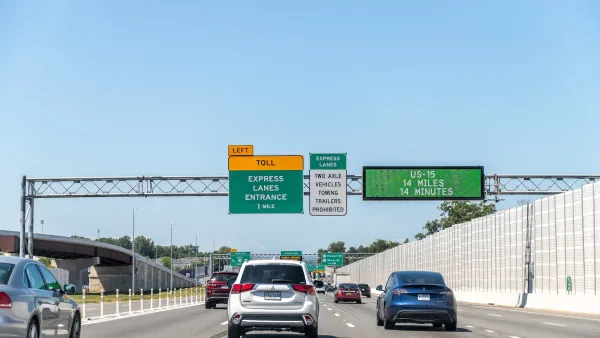
Congestion Costing Reality Check, Part 2: A congestion costing critique
There are good reasons to be skeptical of highway industry claims that traffic congestion is a growing problem. Their analysis is often incomplete and biased. Let’s pull back the curtain on some major congestion cost studies.
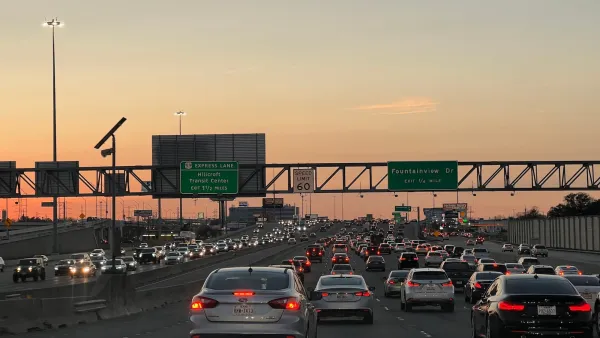
US Traffic Patterns are Shifting, but Car-centric Development Persists
Los Angeles, Honolulu, and San Francisco ranked among the nation’s most congested cities, while New York reduced traffic and increased transit speed and ridership thanks to its congestion pricing program.
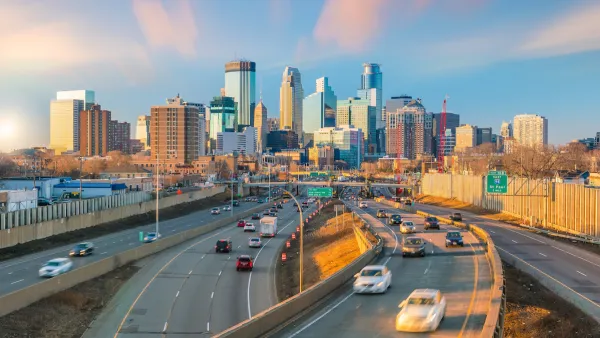
Twin Cities Commutes Faster Than Pre-Pandemic
Workers who have returned to in-person jobs are still experiencing less traffic congestion than in 2019.

Planetizen Federal Action Tracker
A weekly monitor of how Trump’s orders and actions are impacting planners and planning in America.

Eastern Nebraska is running out of electricity
Data centers and electrification are straining eastern Nebraska’s grid, throttling economic development.

Washington state to charge fee to drivers with fuel-efficient cars
Revenue from the fee will go towards supporting the state’s highways.

Instead of building new housing, LA developers are turning mansions into mega-mansions
In the richest areas, the number of houses valued at $30 million with demolition permits has skyrocketed since 2018.

Illinois considers spending $1 billion in taxpayer money on data center
A quantum computing campus and data center are currently under construction in Chicago.

As development costs rise, Boston moves to lessen affordable housing requirements
The Boston Zoning Commission and the City Council still need to approve Boston Mayor Michelle Wu’s proposed changes

FREE Course: Walkable City 1: Why Walkability?
After describing his path towards focusing on walkability as the essence of good planning, Jeff Speck marches through his five principal reasons for making more walkable places.
Reinventing Malls: Planning Alchemy—Turning Gray Fields Into Gold
The course focuses on the opportunities and imperatives that shape reinvention of mall sites.

City of Charlotte
City of Rosemead
Rutgers University, Edward J. Bloustein School of Planning and Public Policy
University of Michigan School for Environment and Sustainability (SEAS)
Hunter College, City University of New York (CUNY)
The Architects Foundation
University District Partnership
City of Cambridge
The Pocatello Development Authority