This essay from Places looks at the history of development in Las Vegas and how the city has rapidly changed the Mojave Desert.


"Las Vegas is located in the Mojave, one of the great deserts of North America, and the expanding city and the desert ecosystem reveal interconnected contradictions. There is the spectacle of the Strip and the dreariness of the everyday city that surrounds it; there are landscapes of success and landscapes of failure; there is the erasure of the past in search of an ever-new future. These contradictions prompt profound concern for the meaning of place. Environmentalists have been hoping that economic downturn would spur reflection and readjustment. Alas, the major players of the American Southwest seem unwilling to forsake the dictum of growth-for-growth's-sake. Large real estate companies, having already secured or entitled hundreds or thousands of acres, remain politically powerful; too often sustainable development means "sustaining development." Even as financial markets were collapsing in late 2008, developers were seeking approval of new developments as neighboring ones slid into foreclosure and bankruptcy."
Read the full story: Urbanizing the Mojave

Study reveals best places in the U.S. for cycling, walking
New research from Streetlight Data examines bicycle and pedestrian miles per capita in the 100 largest U.S. cities by population.
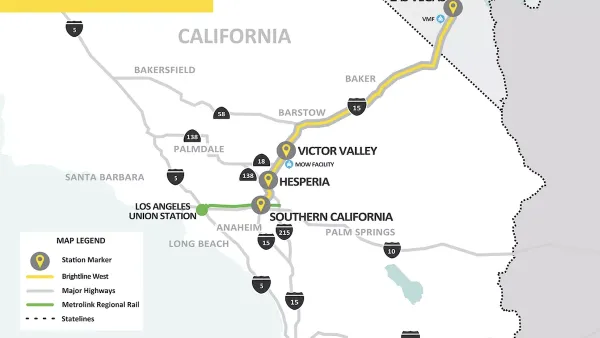
Brightline West’s future may rely on $6 billion federal loan
The company has until Nov. 2 to make a $400 million equity investment into its proposed high-speed rail line.
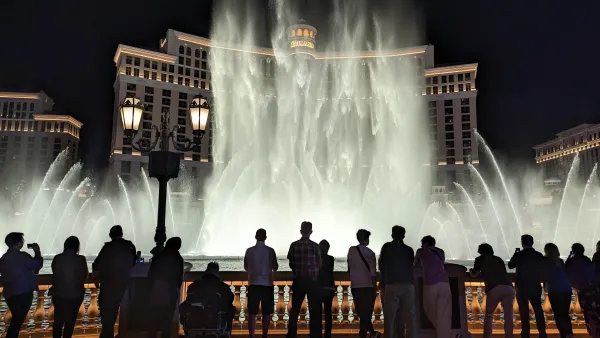
Nevada sues feds to block Colorado River cuts
The federal government’s newly released plan for managing the Colorado River’s dwindling water supply could cause Nevada to lose over 70% of its allocated water.

Planetizen Federal Action Tracker
A weekly monitor of how Trump’s orders and actions are impacting planners and planning in America.

California plans to bury El Niño’s downpour
If the state plays its cards right, it may be able to store a billion acre-feet of El Niño’s water in aquifers.

Desperate measures: Advocates weigh draining Lake Powell to fill Colorado River
Draining the reservoir could reduce evaporation losses by a couple hundred thousand acre-feet.

Housing is the top priority of Seattle’s sole new councilmember
Jenks campaigned on building 1,000 new units of affordable housing.

New tax cuts may slash $1.5 billion in funding for Miami transit, public parks
Amendment 3 will save Miami-Dade homeowners $2,700 in 2028.

Arizona, Wisconsin, Pennsylvania hope to finally advance climate goals post-midterms
The three states have spent years under Republican or divided control.

FREE Course: Walkable City 1: Why Walkability?
After describing his path towards focusing on walkability as the essence of good planning, Jeff Speck marches through his five principal reasons for making more walkable places.
Reinventing Malls: Planning Alchemy—Turning Gray Fields Into Gold
The course focuses on the opportunities and imperatives that shape reinvention of mall sites.

City of Rosemead
Rutgers University, Edward J. Bloustein School of Planning and Public Policy
One Hundred Miles
University of Michigan School for Environment and Sustainability (SEAS)
Hunter College, City University of New York (CUNY)
The Architects Foundation
City of Cambridge
Montrose County
The Pocatello Development Authority