The Bay Area's air pollution regulatory agency may approve in January the nation's first guidelines to limit greenhouse gas emissions for new developments, but it would be up to local governments to enforce them.


The thrust of the new California Environmental Quality Act (CEQA) guidelines appears to prevent sprawl-type development in the Bay Area if cities and counties adopt them. Recent lawsuits by Attorney General Brown may cause them to do just that.
"The Bay Area's air pollution district is proposing the nation's first-ever guidelines for when projects would produce enough global warming gases to warrant an environmental review of ways to reduce them."
"We want to make sure development minimizes its impact on greenhouse gases," said Harry Hilken, director of planning for the nine-county Bay Area Air Quality Management District.
"The state has passed legislation with goals to reduce these emissions in several sectors, but there has been a big void about how to get new development to contribute its fair share", he said.
Thanks to MTC-ABAG Library
FULL STORY: Bay Area pollution district eyes first guidelines for reducing global warming

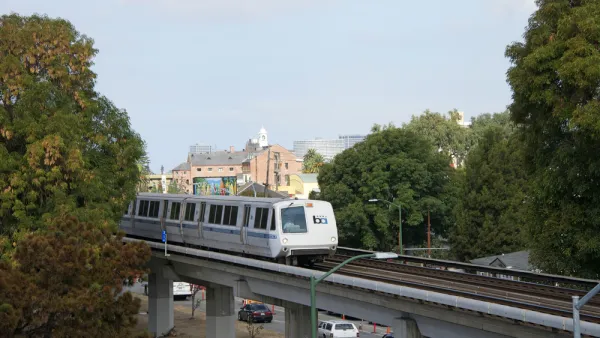
BART's Transit-Oriented Development Bill Sets Disturbing Precedent, Says APA
AB 2923, which would allow the Bay Area Rapid Transit District to rezone their properties near stations for transit-oriented development, passed its first committee. The California chapter of APA objects to the preemption of local land use authority.

Is CEQA the Main Impediment to Housing Construction in California?
According to a new study by UC Berkeley and Columbia University, local land use processes, specifically the approval process, rather than the California Environmental Quality Act, is the main impediment to housing production in California.

Air District Connects Climate Protection to Clean Air Plans
With the adoption of the "Spare the Air - Cool the Climate" program, the Bay Area's air quality regulatory agency has broadened its mission to make reduction of greenhouse gases a paramount goal, along with protecting public health.

Planetizen Federal Action Tracker
A weekly monitor of how Trump’s orders and actions are impacting planners and planning in America.

The state-sanctioned urbicide of Austin
People don’t kill cities. Freeways do.

US to reduce Colorado River water deliveries to Mexico
A new Colorado Treaty amendment reduces Mexico’s Colorado River water allocation by 250,000 acre feet.

Guerilla urbanists are building DIY bus stop benches in Chicago
A before-and-after of one of the bus stops with a new bench. The new benches are not officially sanctioned or permitted, but the residents who placed them hope they will be the start of a network of DIY benches across the city.

Mamdani overhauls NYC's Vision Zero plan with 100 new policy goals
The overhaul aims to reduce traffic deaths and make streets safer for pedestrians, cyclists and drivers through lower speed limits, new safety infrastructure and more.

Amtrak not solely to blame for New Jersey commuter rail's unreliability, report finds
A new study from the Garden State Initiative found that NJ Transit’s budget grew 20% across a 4 year period, but reliability declined significantly over the same period.

FREE Course: Walkable City 1: Why Walkability?
After describing his path towards focusing on walkability as the essence of good planning, Jeff Speck marches through his five principal reasons for making more walkable places.
Reinventing Malls: Planning Alchemy—Turning Gray Fields Into Gold
The course focuses on the opportunities and imperatives that shape reinvention of mall sites.

Eagle County Government
Harvard University Graduate School of Design
Nashville Planning Department
The Architects Foundation
University of Cincinnati Online
The Pocatello Development Authority
The Urban Renewal Agency of the City of Pocatello
Journal of the American Planning Association