This article from Wired UK looks at a handful of emerging transportation concept technologies that are altering the form of the city.


"Birmingham's Intrago Mobility "city port" is an interchange built on waste ground below the M6. When you drive into the port, your long-range Zipcar is directed to a parking space. You get out, stretch your legs a little, and then start the next phase of your journey by getting into a 20mph Toyota iReal (a three-wheeled, one-seat, personal-mobility concept vehicle) and driving it up onto the elevated Velo-city, which leads out of the port. This dedicated new network of cycle tubes criss-crosses the city - connecting city ports with commuter towns and city-centre attractions. Its low-friction surface allows cyclists and light electric vehicles to travel at surprising speed, while its enclosed nature protects them from the elements."
Read the full story: Digital Cities: The transport of tomorrow is already here
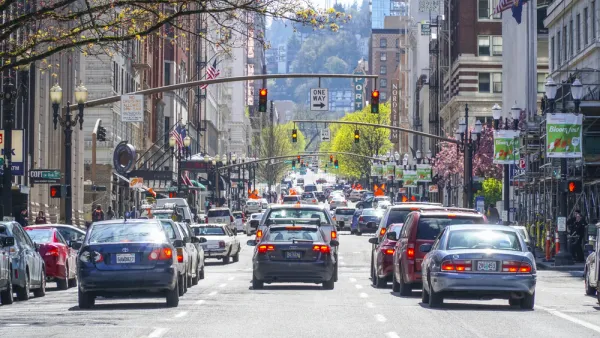
'No Crossing' Signs in Portland Limit the Public Way, Say Critics
In Portland, Oregon, transportation advocates are questioning the justifications for crosswalk closures in the city.
Pedestrian Infrastructure in LA Neighborhood a Study in Contrasts
In Los Angeles’s Boyle Heights neighborhood, some locals are benefiting from public-space improvements as part of the Eastside Access project. But many nearby streets and sidewalks are sorely neglected.
Cyclists, Pedestrians, and Drivers Clash
With over 8 million people sharing the streets and sidewalks of New York City, there is bound to be a clash between transportation modes. Who's to blame? Lyndsey Scofield says that there is bad behavior on all sides.

Planetizen Federal Action Tracker
A weekly monitor of how Trump’s orders and actions are impacting planners and planning in America.

Washington state to charge fee to drivers with fuel-efficient cars
Revenue from the fee will go towards supporting the state’s highways.

Illinois considers spending $1 billion in taxpayer money on data center
A quantum computing campus and data center are currently under construction in Chicago.

Senate passes bill overhauling permitting
The bill still needs to pass the House.

Did data centers change how voters cast their ballots?
Texas, Ohio, and Georgia all flipped party control. But in rural counties, the effect of local data centers was mixed.

Amtrak invests in eight new Airo trainsets
The new trainsets will begin serving passengers in 2031.

FREE Course: Walkable City 1: Why Walkability?
After describing his path towards focusing on walkability as the essence of good planning, Jeff Speck marches through his five principal reasons for making more walkable places.
Reinventing Malls: Planning Alchemy—Turning Gray Fields Into Gold
The course focuses on the opportunities and imperatives that shape reinvention of mall sites.

City of Charlotte
City of Rosemead
Rutgers University, Edward J. Bloustein School of Planning and Public Policy
University of Michigan School for Environment and Sustainability (SEAS)
Hunter College, City University of New York (CUNY)
The Architects Foundation
University District Partnership