Architecture and biomimicry are joining forces. A new city being planned in a flood-prone region of India is using the concept of mimicking nature to build a city that better responds to its environmental conditions.


The city is being built by HOK in partnership with the Biomimicry Guild.
"Recently, the company formed an exclusive alliance with the Biomimicry Guild, a Montana-based consulting organization that pairs consulting biologists with designers, seating architects and ecologists together at the drawing table. When HOK is involved early in a project, an interdisciplinary team of Guild and HOK professionals visits the site to better understand the "genius of place" in order to aid the design team's architectural approach. Faced with constructing a hypothetical building in a desert setting, for example, HOK designers drew inspiration from the barrel cactus, whose vertical ridges work as a self-shading device-something that would cut down artificial cooling loads in the finished structure."
Read the full story: Architecture That Imitates Life

Rethinking New Orleans' Levees
Three design firms offer new ideas for redesigning New Orleans' levees.
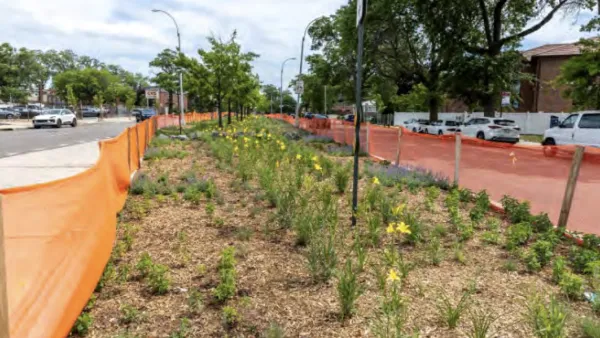
New NYC ‘sponge’ medians will absorb 5 million gallons of stormwater per year
The project will turn three medians in Queens into green infrastructure designed to absorb stormwater.

Study: Historically redlined neighborhoods face higher risk of extreme flooding
A new study indicates that structural disinvestment can translate into serious risk for vulnerable communities.

Planetizen Federal Action Tracker
A weekly monitor of how Trump’s orders and actions are impacting planners and planning in America.

‘Going backwards:’ Baltimore mayor, students rally against state's transit funding plan
Maryland's proposed six-year plan provides no funding for Baltimore’s BMORE bus program and reduces its road maintenance funding.

Detroit to transform waterfront with $2.2 billion investment
Developers will convert about 18 acres of unused parking lot space into civic spaces.

U.S.-Iran war may have ‘devastating’ impact on cost to warm homes
Vermont and Maine residents may see a 76% increase in the cost of warming their homes this winter.

Senate bill would ‘overhaul’ environmental permitting laws
Under the proposed act, government agencies would also not be able to suspend or rescind permits after granting them.

Exemption applications for NYC’s pied-à-terre tax see 55% success rate
The city sent nearly 40% of its initial pied-à-terre tax warnings erroneously.

FREE Course: Walkable City 1: Why Walkability?
After describing his path towards focusing on walkability as the essence of good planning, Jeff Speck marches through his five principal reasons for making more walkable places.
Reinventing Malls: Planning Alchemy—Turning Gray Fields Into Gold
The course focuses on the opportunities and imperatives that shape reinvention of mall sites.

One Hundred Miles
County of Mendocino
planning NEXT
The Architects Foundation
University of Cincinnati Online
Montrose County
Northern Illinois Transit Authority (NITA)
The Pocatello Development Authority