Tracking tags have been implanted in garbage in New York and Seattle to monitor where garbage goes and how municipal waste management systems can improve.


It's all part of a project by the Massachusetts Institute of Technology's SENSEable City Lab, led by Carlo Ratti.
"By plotting the paths of discarded coke bottles, cardboard boxes, and televisions, Ratti and his team want to find ways to improve the system, reducing carbon emissions, relieving traffic congestion in cities (fewer garbage trucks), and increasing the amount of garbage that is diverted from landfills into recycling and composting facilities. 'We want to see if we can develop situations or scenarios of minimum waste, meaning we know where every resource is, where every object is, and we can actually utilize them in an optimal way,' says Assaf Biderman, associate director of the project. 'And the industry is very interested in the type of information we're collecting,' he adds."
Read the full story: Technology in the Trash

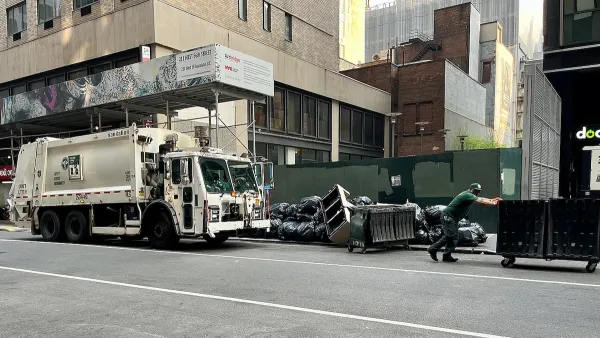
Parked Cars Hamper NYC Trash Containerization Effort
Sanitation workers must manually collect bags from containers blocked by parked cars, slowing a process that is meant to be safer and more efficient.

Unique Garbage Challenges in Juneau
Juneau, Alaska's tiny capital city, is not accessible from elsewhere by road. Its isolation makes waste disposal problematic and expensive, spurring an aggressive recycling effort.
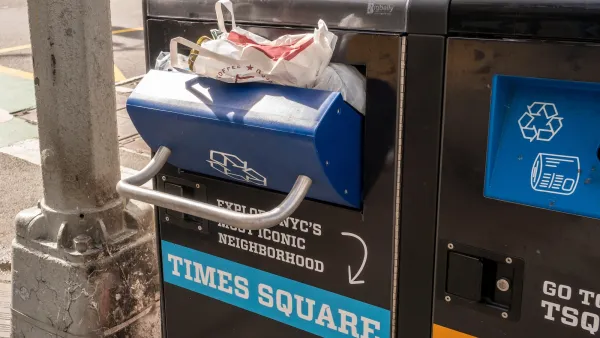
Why is Public Sanitation so Hard?
U.S. cities struggle to keep streets and sidewalks clean. Some are turning to high-tech trash cans to help.

Planetizen Federal Action Tracker
A weekly monitor of how Trump’s orders and actions are impacting planners and planning in America.

Amtrak, CN end decades-long dispute with eight-year agreement
The new operating agreement establishes an updated framework for the companies to work together, including processes to resolve disputes.

Judges permit Denver to divert 77,000 acre feet from the Colorado River for reservoir expansion
Overuse and climate change have caused the Colorado River’s water levels to plummet.

NYC DOT wants faster, more permanent street upgrades
The city is examining ways to build more concrete infrastructure without getting entangled in 'decades-long' projects.

'Something we’ve never seen before:' rising utility rates could strain city finances nationwide
Data centers, climate change and other factors have caused utility rates in the United States to increase by 38% since 2020.

Trump to overrule local leaders, lease millions of acres of America’s Pacific Island territories’ seafloors to mining companies
International law says that the Indigenous people of America’s territories have a right to prior and informed consent regarding projects that impact their countries.

FREE Course: Walkable City 1: Why Walkability?
After describing his path towards focusing on walkability as the essence of good planning, Jeff Speck marches through his five principal reasons for making more walkable places.
Reinventing Malls: Planning Alchemy—Turning Gray Fields Into Gold
The course focuses on the opportunities and imperatives that shape reinvention of mall sites.

Harvard University Graduate School of Design
KFH Group Inc.
Greater Baltimore Committee
The Architects Foundation
University of Cincinnati Online
The Pocatello Development Authority
The Urban Renewal Agency of the City of Pocatello