Community participation is on the rise, and many sociologists think it's related to the recession.


"Some sociologists and community organizers say they think there has been an uptick of "neighboring" in the recession, as residents are reaching out, in person and through e-mail discussion groups. They're talking crime and the economy, helping others through job losses and organizing money-saving potlucks.
Although the evidence is still largely anecdotal - U.S. Census and other data won't be available until later this year - some scholars say the numbers of those involved in community activities could increase for the first time in years, after a long downward spiral that began in the 1970s because of longer commutes and time pressure on two-income families.
Historically, economic hard times can be tough on civic engagement, as when involvement dropped during the Great Depression. But experts say that doesn't take into account new social technologies, a burst of political involvement among youths, and a president who has inspired many."
Read the full story: In hard times, an uptick in "neighboring"
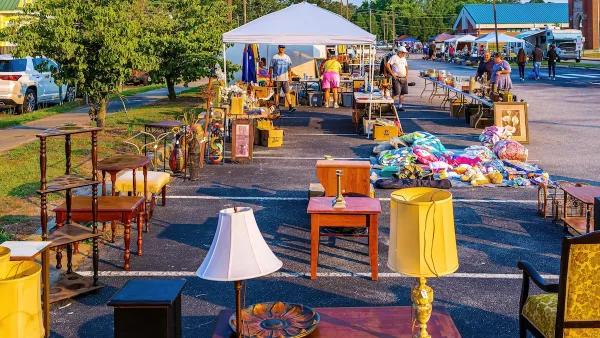
The “Hundred Mile” Yard Sales That Turn Rural Highways into Treasure Trails
From Kentucky to Florida to Washington State, a delightful culture of impossibly long yard sales helps communities thrive.

This City Will Pay You to Meet Your Neighbors
A North Kansas City grant program offers up to $400 for residents to throw neighborhood block parties.

For Some, Co-Housing Offers Social and Economic Benefits
Residents of co-living developments say the built-in community helps ease the growing isolation felt by many Americans.

Planetizen Federal Action Tracker
A weekly monitor of how Trump’s orders and actions are impacting planners and planning in America.

California plans to bury El Niño’s downpour
If the state plays its cards right, it may be able to store a billion acre-feet of El Niño’s water in aquifers.

Desperate measures: Advocates weigh draining Lake Powell to fill Colorado River
Draining the reservoir could reduce evaporation losses by a couple hundred thousand acre-feet.

Los Angeles just elected an urban planner as its mayor
Transportation analysts are optimistic that Raman will be more aggressive in addressing transit issues than Bass.

Mamdani’s pied-à-terre tax survives legal challenge
A panel of judges found that the plaintiffs failed to demonstrate injury as a result of New York City's implementation of the tax.

Eastern Nebraska is running out of electricity
Data centers and electrification are straining eastern Nebraska’s grid, throttling economic development.

FREE Course: Walkable City 1: Why Walkability?
After describing his path towards focusing on walkability as the essence of good planning, Jeff Speck marches through his five principal reasons for making more walkable places.
Reinventing Malls: Planning Alchemy—Turning Gray Fields Into Gold
The course focuses on the opportunities and imperatives that shape reinvention of mall sites.

City of Rosemead
Rutgers University, Edward J. Bloustein School of Planning and Public Policy
One Hundred Miles
University of Michigan School for Environment and Sustainability (SEAS)
Hunter College, City University of New York (CUNY)
The Architects Foundation
City of Cambridge
Montrose County
The Pocatello Development Authority