The EPA's proposal to list the Gowanus Canal as a Superfund site is getting mixed reactions from nearby residents and officials: some see the designation as a development-halting stigma, others as quite the opposite.


"Experts on contaminated sites said that a Superfund listing typically stirs contradictory emotions. On one hand, some people who live nearby may feel demoralized and even frightened by the finding of serious contamination and worry about its impact on real estate values; on the other, some are often relieved to get a firm commitment to clean up the toxic substances in their midst.
'It's very common to have the division between those who see it as terrible and those who see it as an opportunity,' said Kris Wernstedt, an associate professor of urban affairs and planning at Virginia Tech's Alexandria campus who specializes in Superfund and brownfield issues.
Studies have shown that property values decline after a Superfund listing but rebound after the cleanup, sometimes to far higher levels, he said.
The proposed designation has put Mayor Michael R. Bloomberg, who has championed a greener New York, in the odd position of opposing the New York State Department of Environmental Conservation, which requested the Superfund listing for the canal."
Read the full story: On the Gowanus Canal, Fear of Superfund Stigma

Will a Brooklyn Superfund Site Become the Borough's Next Hot Nabe?
On-again, off-again, and now back on-again plans to redevelop the polluted area between two of Brooklyn's most affluent neighborhoods have the residents of Gowanus divided on the direction of their gritty community.
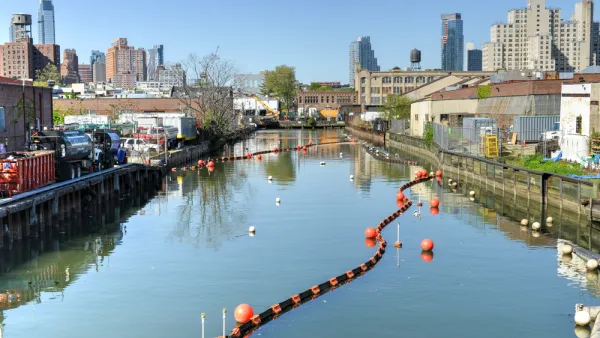
Big Day for Brooklyn: Gowanus Canal Clean Up Begins
Local advocates are celebrating the start of clean up work on the Gowanus Canal in Brooklyn.
NYC Unveils Plans for Cleaning Up One of Its Most Polluted Waterways
The EPA has released plans for how it intends to clean up Brooklyn's Gowanus Canal Superfund site. Branden Klayko reports on the $500 million, two pronged approach.

Planetizen Federal Action Tracker
A weekly monitor of how Trump’s orders and actions are impacting planners and planning in America.

Chicago breaks ground on $3 billion megadevelopment
The new neighborhood, titled Foundry Park, will one day host 3,700 residences.

This MA town is drowning in its own sewage — and residents like it that way
Susan Murcott, a waste water expert, said if Carlisle didn't address their leaking sewage, the problem could turn “deadly.”

Feds to more closely scrutinize proposed Amtrak facility’s environmental impact
The Federal Railroad Administration had initially said the facility qualified for a less extensive environmental review.

Boston is hard to build housing in: its chief of planning wants to keep it that way
Chief of Planning Kairos Shen said she would not make changes to Boston’s affordability requirements for new housing, which critics say have slowed down development.

California plans to bury El Niño’s downpour
If the state plays its cards right, it may be able to store a billion acre-feet of El Niño’s water in aquifers.

FREE Course: Walkable City 1: Why Walkability?
After describing his path towards focusing on walkability as the essence of good planning, Jeff Speck marches through his five principal reasons for making more walkable places.
Reinventing Malls: Planning Alchemy—Turning Gray Fields Into Gold
The course focuses on the opportunities and imperatives that shape reinvention of mall sites.

City of Rosemead
Rutgers University, Edward J. Bloustein School of Planning and Public Policy
One Hundred Miles
Hunter College, City University of New York (CUNY)
The Architects Foundation
University of Cincinnati Online
Montrose County
The Pocatello Development Authority
The Urban Renewal Agency of the City of Pocatello