An ambitious HUD program promoting homeownership in troubled neighborhoods is, by some accounts, "one of the more intelligent things HUD has done in its history."


"The idea to rescue Canal Banks and 10 other unstable areas nationwide relies on an idea – homeownership – that now might seem almost quaint, if not misguided. The Homeownership Zone (HOZ) demonstration program, launched in 1996 by the US Department of Housing and Urban Development, has tried to turn entire neighborhoods around by flooding small, poverty-stricken areas with hundreds of new homes to be purchased by working-class, mostly first-time home buyers.
And it's an effort that seems to be working. Only a small handful of homes have gone into foreclosure – the result, administrators say, of extensive, mandatory pre-and postmortgage counseling that steered homeowners away from adjustable-rate loans.
'The intent was really to remake these neighborhoods, to give them some sort of identity,' says John Kromer, a senior consultant at the Fels Institute of Government at the University of Pennsylvania and Philadelphia's former director of housing. 'It was very ambitious.... It really was a radical departure from what had been done before.'"
Read the full story: NJ city: surprising leader in affordable housing

Analysis: ROAD to Housing Act could take years to implement
HUD is tasked with implementing nine new rules as part of the ROAD to Housing Act — while operating with a significantly reduced staff.

How HUD is dismantling fair housing enforcement
Fair housing law has never been easy to enforce. But HUD's proposal to eliminate the use of disparate impact analysis will remove another crucial tool for doing so.
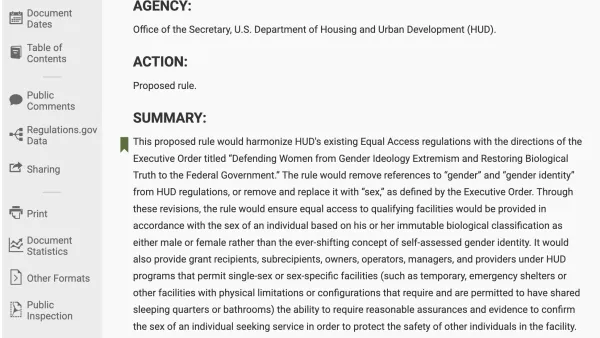
New HUD rule would remove gender from housing protections
The proposal in the federal registry would replace “gender” and “gender identity” with “sex” as defined by Trump’s January, 2025 executive order.

Planetizen Federal Action Tracker
A weekly monitor of how Trump’s orders and actions are impacting planners and planning in America.

California plans to bury El Niño’s downpour
If the state plays its cards right, it may be able to store a billion acre-feet of El Niño’s water in aquifers.

Desperate measures: Advocates weigh draining Lake Powell to fill Colorado River
Draining the reservoir could reduce evaporation losses by a couple hundred thousand acre-feet.

Los Angeles just elected an urban planner as its mayor
Transportation analysts are optimistic that Raman will be more aggressive in addressing transit issues than Bass.

Mamdani’s pied-à-terre tax survives legal challenge
A panel of judges found that the plaintiffs failed to demonstrate injury as a result of New York City's implementation of the tax.

Eastern Nebraska is running out of electricity
Data centers and electrification are straining eastern Nebraska’s grid, throttling economic development.

FREE Course: Walkable City 1: Why Walkability?
After describing his path towards focusing on walkability as the essence of good planning, Jeff Speck marches through his five principal reasons for making more walkable places.
Reinventing Malls: Planning Alchemy—Turning Gray Fields Into Gold
The course focuses on the opportunities and imperatives that shape reinvention of mall sites.

City of Rosemead
Rutgers University, Edward J. Bloustein School of Planning and Public Policy
One Hundred Miles
University of Michigan School for Environment and Sustainability (SEAS)
Hunter College, City University of New York (CUNY)
The Architects Foundation
City of Cambridge
Montrose County
The Pocatello Development Authority