The 2008 Summer Olympics brought a boom of construction to host city Beijing. But now, six months later, much of the office space built in the lead up to the games sits empty -- and likely will for years.


"Beijing went through a building boom before the 2008 Summer Olympics that filled a staid communist capital with angular architectural feats that grace the covers of glossy design magazines."
"Now, six months after the Games ended, the city continues to dazzle by night, with neon and floodlights dancing across the skyline. By day, though, it is obvious that many are "see-through" buildings, to use the term coined during the Texas real estate bust of the 1980s."
"By Rodman's calculations, 500 million square feet of commercial real estate has been developed in Beijing since 2006, more than all the office space in Manhattan. And that doesn't include huge projects developed by the government. He says 100 million square feet of office space is vacant -- a 14-year supply if it filled up at the same rate as in the best years, 2004 through '06, when about 7 million square feet a year was leased."
Read the full story: Beijing's Olympic building boom becomes a bust
In the Eye of Beijing's Boom
This article from National Geographic looks at the construction boom that is rapidly changing the face of Beijing.
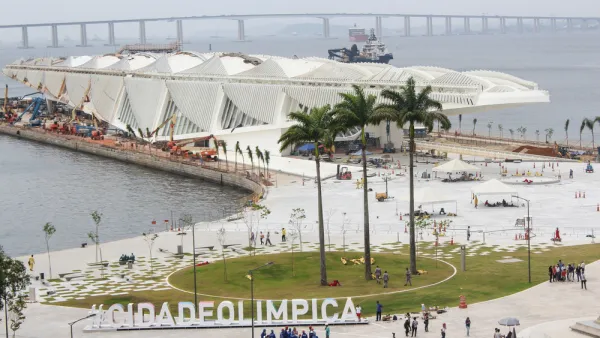
Abandoned Olympic Venues Cast Doubt on the Value of Hosting
Though cities hope for an economic boost, these photos show it's far from guaranteed.
Can Madrid's Bid for a Thrifty Olympics Succeed?
As the start of London's summer games grows near, the competition to host the 2020 Olympics is heating up. Paul Sonne looks at whether the "shoestring" bid of Madrid, formed amidst Spain's austerity drive, can beat out the other finalists.

Planetizen Federal Action Tracker
A weekly monitor of how Trump’s orders and actions are impacting planners and planning in America.

California plans to bury El Niño’s downpour
If the state plays its cards right, it may be able to store a billion acre-feet of El Niño’s water in aquifers.

Desperate measures: Advocates weigh draining Lake Powell to fill Colorado River
Draining the reservoir could reduce evaporation losses by a couple hundred thousand acre-feet.

In Texas, data centers are swallowing promised parkland
Residents who moved to Taylor, Texas for a rural community now have to contend with three data centers in their backyard.

How a Chicago-sized wind farm beat the odds and powered on
The project spanned five presidential administrations and a standoff with a U.S. military base.

MTA gives itself 30 days to transform pit into basketball court
The site has been under construction since 2022; the city originally estimated it would finish the court in 2024.

FREE Course: Walkable City 1: Why Walkability?
After describing his path towards focusing on walkability as the essence of good planning, Jeff Speck marches through his five principal reasons for making more walkable places.
Reinventing Malls: Planning Alchemy—Turning Gray Fields Into Gold
The course focuses on the opportunities and imperatives that shape reinvention of mall sites.

City of Rosemead
Rutgers University, Edward J. Bloustein School of Planning and Public Policy
One Hundred Miles
Hunter College, City University of New York (CUNY)
The Architects Foundation
University of Cincinnati Online
City of Cambridge
Montrose County
The Pocatello Development Authority