The newly passed stimulus bill's sustainability elements are blessings for green builders and environmentalists. As far as commercial property owners are concerned, however, those elements may be seen as too much work for little benefit.


"The $819 billion stimulus bill that passed a vote in the House on Jan. 28 would help landlords invest in alternative energy systems for onsite power generation, but the plan's other green components are aimed at homeowners, federal buildings, schools and new product development.
Commercial property owners who want government assistance or at least tax breaks to offset the cost of better insulation, power-saving light fixtures or high-efficiency heating, ventilation and air conditioning can appeal to city and state government programs, which will receive block grants under the stimulus program. The programs funded by those grants will vary by location, [vice president of advocacy at the Building Owners and Managers Association International Karen] Penafiel says.
'With the block grants to the states, there may still be opportunities at the state level to direct some of that money to energy efficiency in buildings,' she says. "There's a lot of discretion for the mayors on how to spend that funding."
Read the full story: Stimulus Bill’s Sustainability Elements Disappoint Commercial Landlords

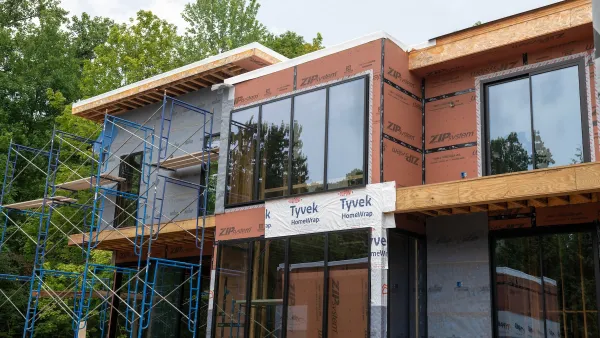
New HUD guidelines call for nixing green building requirements
The newly released 'best practices' advise local governments to streamline permitting processes, cap permitting fees and encourage by-right development of single-family homes.

Chicago Approves Green Affordable Housing Plan
The Mayor’s plan calls for creating a nonprofit housing corporation tasked with building affordable housing that meets Green Building standards.

Advancing Sustainability in Los Angeles County Schools
The Los Angeles County Office of Education’s Green Schools Symposium brings together educators, students, and experts to advance sustainability in schools through innovative design, climate resilience strategies, and collaborative learning.

Planetizen Federal Action Tracker
A weekly monitor of how Trump’s orders and actions are impacting planners and planning in America.

‘Going backwards:’ Baltimore mayor, students rally against state's transit funding plan
Maryland's proposed six-year plan provides no funding for Baltimore’s BMORE bus program and reduces its road maintenance funding.

Detroit to transform waterfront with $2.2 billion investment
Developers will convert about 18 acres of unused parking lot space into civic spaces.

HUD modernizes 50-year-old manufactured housing framework
The Next Generation Manufactured Housing Action Plan establishes new energy-efficiency standards for manufactured homes, and new guidelines for anchoring them.

New CA housing laws tear down development red tape
Recently-signed legislation makes building starter homes and ADUs cheaper and faster in California.

Metrolink finishes first expansion in 20 years
The transit agency is now one of very few in the United States to connect two major airports.

FREE Course: Walkable City 1: Why Walkability?
After describing his path towards focusing on walkability as the essence of good planning, Jeff Speck marches through his five principal reasons for making more walkable places.
Reinventing Malls: Planning Alchemy—Turning Gray Fields Into Gold
The course focuses on the opportunities and imperatives that shape reinvention of mall sites.

One Hundred Miles
County of Mendocino
planning NEXT
The Architects Foundation
University of Cincinnati Online
Montrose County
Northern Illinois Transit Authority (NITA)
The Pocatello Development Authority