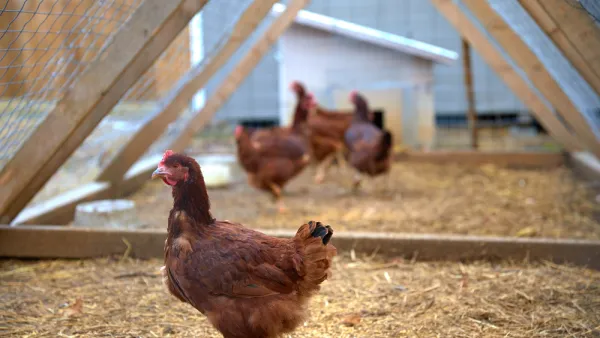
Municipalities are increasingly ready to meet the rising demands by residents who want to raise their own chickens for food.


"Forget growing your own vegetables - cutting-edge locavores are now pushing backyard honey, eggs and milk. Researchers with the American Planning Association say that in the past six months they've fielded more questions about livestock ordinances than almost any other topic.
Colorado zoning consultant Christopher Duerksen is trying to simplify some of the answers. He's putting together a model sustainability code for cities trying to green up their rules.
Asked how city planners tend to react when they hear the word 'chicken,' Duerksen quips: 'They tend to squawk. I think most planners, like most people, don't think of urban areas as food producing areas, but that's changing with the cost of food and questions about the health of food. And so we're seeing a real change in mindset among urban planners.'
This means residents can now keep bees in Denver or raise a mini-goat in Seattle. But the real rock stars of this movement are chickens.
Urban livestock researcher Jennifer Blecha says that in recent years a dozen or more cities annually have joined the pro-chicken flock. And she says chicken advocates are starting to get more organized."
Read the full story: City Folk Flock To Raise Small Livestock At Home

Proposed Ordinance Would Limit Livestock Ownership in Chicago
In an effort to elevate a standard of care for livestock, an ordinance sponsored by Ald. Anthony Napolitano seeks to regulate fowl and livestock animal ownership within city limits.
Ordinance Would Limit Chickens, Livestock in Chicago Residential Neighborhoods
Noise and smeall are the common complaints as more residents of urban areas bring animals to their home to live more sustainably.
Coming Soon to Detroit: An Urban Livestock Ordinance
Planners and citizens in Detroit are wrapping up a year's worth of research and community engagement before drafting an urban livestock ordinance.

Planetizen Federal Action Tracker
A weekly monitor of how Trump’s orders and actions are impacting planners and planning in America.

Chicago breaks ground on $3 billion megadevelopment
The new neighborhood, titled Foundry Park, will one day host 3,700 residences.

This MA town is drowning in its own sewage — and residents like it that way
Susan Murcott, a waste water expert, said if Carlisle didn't address their leaking sewage, the problem could turn “deadly.”

Feds to more closely scrutinize proposed Amtrak facility’s environmental impact
The Federal Railroad Administration had initially said the facility qualified for a less extensive environmental review.

Boston is hard to build housing in: its chief of planning wants to keep it that way
Chief of Planning Kairos Shen said she would not make changes to Boston’s affordability requirements for new housing, which critics say have slowed down development.

California plans to bury El Niño’s downpour
If the state plays its cards right, it may be able to store a billion acre-feet of El Niño’s water in aquifers.

FREE Course: Walkable City 1: Why Walkability?
After describing his path towards focusing on walkability as the essence of good planning, Jeff Speck marches through his five principal reasons for making more walkable places.
Reinventing Malls: Planning Alchemy—Turning Gray Fields Into Gold
The course focuses on the opportunities and imperatives that shape reinvention of mall sites.

City of Rosemead
Rutgers University, Edward J. Bloustein School of Planning and Public Policy
One Hundred Miles
Hunter College, City University of New York (CUNY)
The Architects Foundation
University of Cincinnati Online
Montrose County
The Pocatello Development Authority
The Urban Renewal Agency of the City of Pocatello