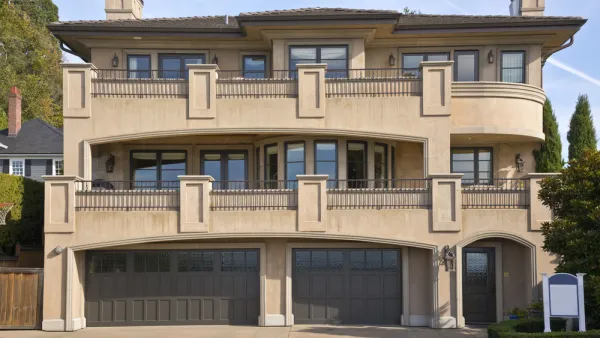
A new study from SMR Research Corporation reveals that people who live alone use 18% more energy than two-person households, and 30% more than three-person homes. McMansions are, or course, cited as big wasters.


"Household density is the key problem in over-consumption. In 2007, the U.S. hit a new record low of 2.56 persons per household. The data show that Americans are now spending 29.6 percent more on energy per capita than in 1960, based solely on the decline in density.
SMR's study is based on its work with the "micro-data" files of the Consumer Expenditures Survey (CES), conducted by the Census Bureau on behalf of the Bureau of Labor Statistics. These large, complex files contain raw data on household spending on hundreds of products, allowing a researcher to isolate any product and compare spending patterns to the characteristics of families. SMR used data from 27,159 household interviews conducted in 2006 and 2007, the most recent available."
Thanks to Reconnecting America
Read the full story: Singles Use More Energy?

On the Massive Carbon Savings of Gentle Density
A thought experiment compares the carbon impact of three new single family homes with the same block if it contained a duplex, a triplex, and a fourplex.
Zoning Changes Would Mean More Granny Flats and Fewer McMansions in Seattle
Is this a two-birds-with-one-stone situation?
New Jersey Moves Away From McMansion Trend
In the face of a recent report showing that sprawl was rapidly eating up developable land in New Jersey, developers have begun to ditch the McMansion in favor of taller and more dense projects.

Planetizen Federal Action Tracker
A weekly monitor of how Trump’s orders and actions are impacting planners and planning in America.

California plans to bury El Niño’s downpour
If the state plays its cards right, it may be able to store a billion acre-feet of El Niño’s water in aquifers.

Desperate measures: Advocates weigh draining Lake Powell to fill Colorado River
Draining the reservoir could reduce evaporation losses by a couple hundred thousand acre-feet.

Los Angeles just elected an urban planner as its mayor
Transportation analysts are optimistic that Raman will be more aggressive in addressing transit issues than Bass.

Mamdani’s pied-à-terre tax survives legal challenge
A panel of judges found that the plaintiffs failed to demonstrate injury as a result of New York City's implementation of the tax.

Eastern Nebraska is running out of electricity
Data centers and electrification are straining eastern Nebraska’s grid, throttling economic development.

FREE Course: Walkable City 1: Why Walkability?
After describing his path towards focusing on walkability as the essence of good planning, Jeff Speck marches through his five principal reasons for making more walkable places.
Reinventing Malls: Planning Alchemy—Turning Gray Fields Into Gold
The course focuses on the opportunities and imperatives that shape reinvention of mall sites.

City of Rosemead
Rutgers University, Edward J. Bloustein School of Planning and Public Policy
One Hundred Miles
University of Michigan School for Environment and Sustainability (SEAS)
Hunter College, City University of New York (CUNY)
The Architects Foundation
City of Cambridge
Montrose County
The Pocatello Development Authority