In the face of a recent report showing that sprawl was rapidly eating up developable land in New Jersey, developers have begun to ditch the McMansion in favor of taller and more dense projects.


More and more builders are changing their strategies in favor of smaller projects, and a rising number of developers are conceding that McMansions probably aren't the best future for the state.
"'You have to build not simply for the market we've experienced in the past, but for where the country is headed. Energy prices could soar. The price of the little remaining open space is unattainable,' Robert G. Torricelli, a former senator who now has a development company, said in a telephone interview.
'What will trigger denser development is that there's no space left, and what is left no one can build on,' said David Henderson, a principal at HHG Development Associates, a Trenton company that focuses on sustainable building practices. According to the Rowan and Rutgers report, New Jersey is poised to become the first state to develop every acre of unprotected land, a milestone researchers predict will happen 'sometime within the middle of the century.' But whatever the imperative, a number of untraditional projects seem to be finding acceptance with home buyers. "
Read the full story: Builders Move Beyond McMansions in New Jersey
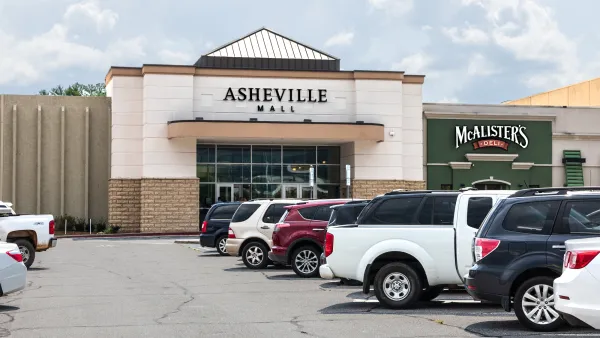
Asheville reconsiders parking minimums as surface parking eats up over a third of downtown real estate
Housing advocates say parking requirements are unnecessary and induce sprawl.

Texas Could Have the Nation’s 3 Largest Cities by 2100. Are They Ready to Embrace Density?
Houston, Dallas, and Austin are growing fast. The old sprawl model is no longer sustainable.

Boulder Eliminates Parking Minimums Citywide
Officials estimate the cost of building a single underground parking space at up to $100,000.

Planetizen Federal Action Tracker
A weekly monitor of how Trump’s orders and actions are impacting planners and planning in America.

California plans to bury El Niño’s downpour
If the state plays its cards right, it may be able to store a billion acre-feet of El Niño’s water in aquifers.

Desperate measures: Advocates weigh draining Lake Powell to fill Colorado River
Draining the reservoir could reduce evaporation losses by a couple hundred thousand acre-feet.

Los Angeles just elected an urban planner as its mayor
Transportation analysts are optimistic that Raman will be more aggressive in addressing transit issues than Bass.

Mamdani’s pied-à-terre tax survives legal challenge
A panel of judges found that the plaintiffs failed to demonstrate injury as a result of New York City's implementation of the tax.

Eastern Nebraska is running out of electricity
Data centers and electrification are straining eastern Nebraska’s grid, throttling economic development.

FREE Course: Walkable City 1: Why Walkability?
After describing his path towards focusing on walkability as the essence of good planning, Jeff Speck marches through his five principal reasons for making more walkable places.
Reinventing Malls: Planning Alchemy—Turning Gray Fields Into Gold
The course focuses on the opportunities and imperatives that shape reinvention of mall sites.

City of Rosemead
Rutgers University, Edward J. Bloustein School of Planning and Public Policy
One Hundred Miles
University of Michigan School for Environment and Sustainability (SEAS)
Hunter College, City University of New York (CUNY)
The Architects Foundation
City of Cambridge
Montrose County
The Pocatello Development Authority